
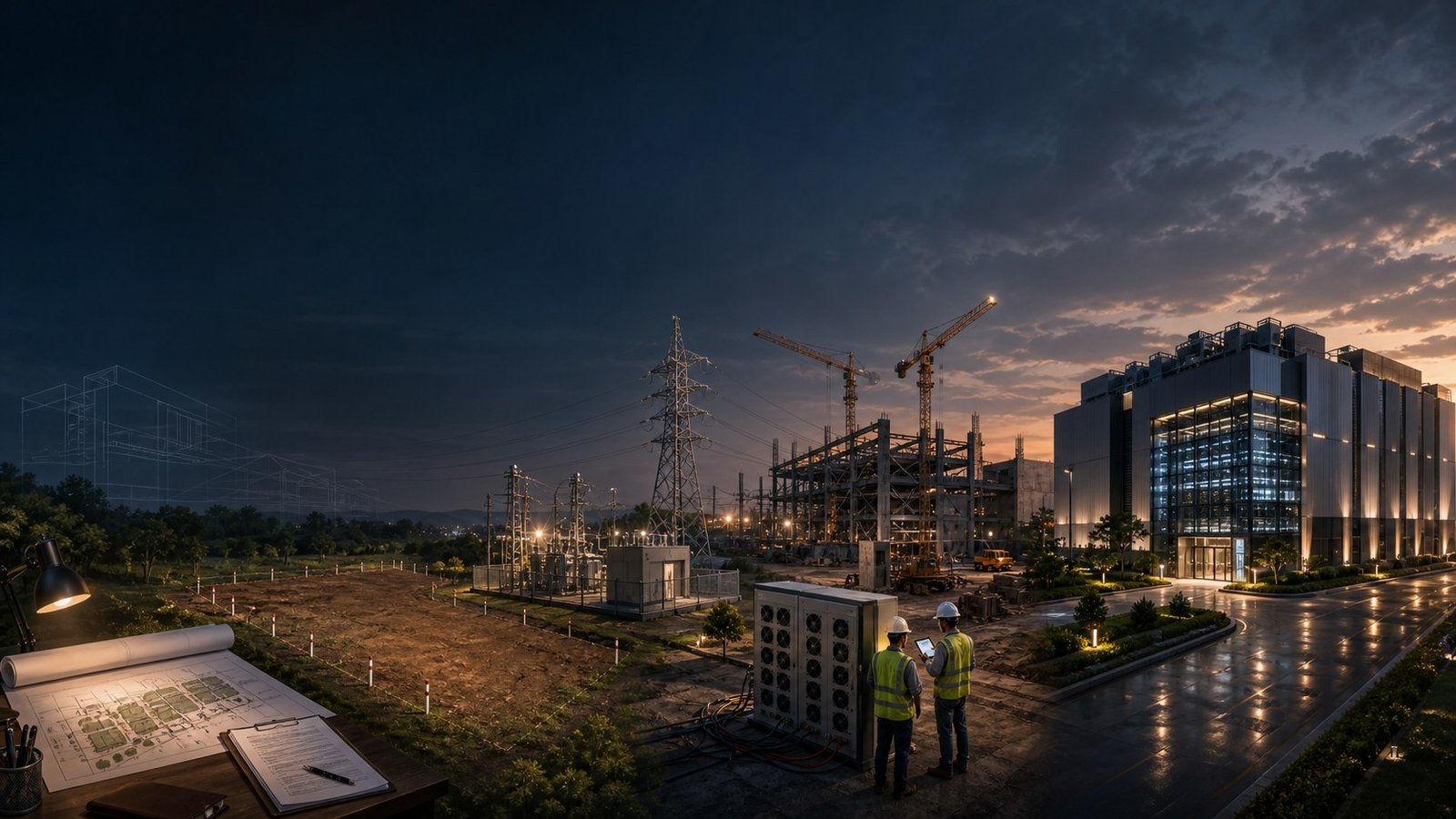
What should count as “live”—and what public sources actually confirm.
Research cut-off: 13 October 2026 (IST). This is an evergreen diligence guide, not a census of every Indian data-centre project. Examples below are dated to the public source cited; an announcement is not a live-status update, and a later source should be checked before reusing any status claim.

The short answer: a 1GW plan is not 1GW live
A 1GW headline can refer to a long-term campus ambition, a platform target, an announced build-out or a collection of future phases. It does not, by itself, say how much land is under executed control, how much firm power can reach a particular phase, how much is being built, how much has passed commissioning, or what customers can use today.
For this guide, “commercially live” is an editorial threshold, not a universal legal or industry certification. Apply it to a named building, phase or service—not automatically to a parent campus. A phase may be called commercially live when a dated, credible public source confirms that it is operational or ready for service and available for customer use, handed over to a customer, or supporting a cloud service that has reached general availability. State the source’s capacity basis and the date. If no physical MW is disclosed, say so.
Even a phase that is commercially available is not necessarily fully leased, occupied, drawing its maximum power or running at full utilization. “Live” is a service/readiness claim; utilization is a separate measure. A cloud region’s general availability can confirm that a service is live without disclosing how many megawatts of data-centre capacity support it.
The six labels below help readers describe evidence precisely. They are not a mandatory construction sequence, a legal status ladder, or a score of a company’s execution.
The six milestones at a glance
| Milestone | What it means in this guide | Public evidence that can support it | What the evidence alone does not prove |
|---|---|---|---|
| Announcement | A company, government or project partner has stated an intention, target or plan. | Dated company release, exchange filing, signed agreement or public government record. | Land control, financing drawdown, a power connection, construction, commissioning or capacity available today. |
| Land | A site or parcel has been identified, allocated, contracted, transferred or placed in possession—each is a different claim. | Parcel-specific allotment/order; executed and registered lease or transfer; possession/handover record; company statement with exact wording. | That an approval became an executed transaction; that all parcels are assembled; or that the site is buildable, powered or operational. |
| Power | A source describes a power arrangement for a named site or phase. | Site-specific utility sanction, executed supply/PPA documentation, connection/energization record, or an operator’s dated statement that power is secured. | That generation capacity is deliverable to the site, the connection is energized, the full planned load is firm, or the data hall is ready. |
| Construction | Physical development is under way, or a defined construction milestone has been reported. | Dated site progress, contractor or operator update, permit/inspection record, or an explicitly described groundbreaking. | Completion, tested systems, usable IT capacity or service availability. A ceremony does not establish progress across every phase. |
| Commissioning | Systems are being verified against the design and operating requirements for a defined facility or phase. | Commissioning plan or report; functional and integrated-systems test evidence; operator confirmation that a named phase passed relevant testing. | Customer handover, commercial availability, tenant occupancy, cloud-service GA or sustained utilization. |
| Commercially live | A named phase or service is operational/ready for service and available to customers, handed over, or confirmed at general availability. | Dated operator/customer RFS or operational statement, handover confirmation, named customer service launch or cloud-service GA. | That the entire campus is live, every planned MW is installed, the space is fully leased, or all capacity is being used. |

The six labels are not a universal legal sequence
The arrow in the headline is a reading aid, not a claim that every project advances in a neat one-way line. Power procurement, design, permitting, land assembly, financing and construction can overlap. A developer can secure a site while negotiating power; a utility connection can be planned before a building is complete; commissioning can begin on one system or building while another is still under construction. A customer can contract for capacity before the relevant phase is ready.
The useful unit is usually the phase. One campus can contain an operating first building, a second building under construction and a third still in planning. A region or platform target can span several sites. Status should therefore be attached to the smallest public unit the source actually identifies: a building, phase, hall, campus, utility connection, customer handover or cloud service.
Treat a project register as a dated evidence log, not a single traffic-light label. Keep separate rows for different phases and update each one only when a new source supports the change. If an official release says a campus is “up to 1GW” and separately describes the first phase, do not promote the campus total to the phase’s operating capacity.
1. Announcement: record the intent, not the supply
An announcement is evidence that a plan, target, partnership, investment intention or project has been publicly stated. It is important: it may signal demand, a site search, an anchor customer or a long-term infrastructure strategy. But it is the starting point for a status check, not proof that the physical asset exists.
What to capture
- Who made the statement, and whether it is the developer, customer, government, investor or a partner speaking about someone else’s project.
- The date, exact wording and scope: one building, a campus, several cities, an India-wide target or a wider AI/cloud investment.
- Whether the figure is “up to,” “planned,” “expected,” “proposed,” “gigawatt-scale,” an option or a committed phase.
- Whether the source defines the MW basis—IT load, gross facility capacity, grid connection or another measure.
- Any stated dependencies: approvals, customer demand, financing, power, phased build-out or a future target date.
A headline such as “1GW AI campus” can describe an intended full build-out. An investment commitment is not necessarily cash deployed, a land purchase or an operating building. An MoU can document intent without establishing that all approvals or conditions have been completed. A power target in a policy or a company’s national platform ambition is not site-specific power evidence.
Example — CoreWeave–AdaniConneX, 6 October 2026. CoreWeave said it plans 240MW of data-centre capacity at Taloja in three 80MW buildings, with the first phase expected to be available in mid-2028 and further capacity coming in phases. The release does not state that those megawatts were live on 6 October 2026. It also does not define the 240MW basis as IT load, gross facility load or grid demand. The accurate status at the research cut-off is announced/planned, with a future first-phase target, not 240MW operational.
Safer wording: “The company announced a phased 240MW Taloja plan on 6 October 2026; it expects the first phase to be available in mid-2028. The release does not report the project as operational or define the MW basis.”
2. Land: an approval, a contract and possession are different facts
“Land secured” is one of the easiest phrases to over-read. In public records and press releases, the apparent milestone may be a site selection, an application, an in-principle approval, an allotment approval, an executed lease, a registered conveyance, payment, handover or physical possession. Those events may be conditional and may concern different parcels.
Use the source’s exact verb and identify the parcel and party. Where possible, check the primary order or transaction document, parcel schedule, registration record, payment condition and possession record. A government allocation to a project company is not automatically proof that the operating company has title or physical control. A public announcement that a company “secured” land should be reported as the company’s statement unless the underlying legal record has been independently checked.
| Land evidence found | Careful label | Do not silently upgrade it to |
|---|---|---|
| State policy, site search or proposed location | Proposed / identified | Allocated, acquired or in hand |
| In-principle approval or allotment approval | Approved / provisionally allocated, as the record says | Registered transfer or physical possession |
| Executed agreement or registered lease/transfer | Contracted / transferred under the stated instrument | All conditions met or full site possession, unless the record says so |
| Parcel-specific handover/possession evidence | Possession reported for the stated parcels and date | Complete land assembly, permits, power or construction readiness |
Example — TCS HyperVault, 5 September 2026. TCS’s press release and stock-exchange filing say HyperVault “has secured 264 acres of land” for a Hyderabad AI data-centre campus of up to 1GW, to be developed in phases. Those sources support reporting that HyperVault/TCS publicly described 264 acres as secured and that the ultimate campus target is up to 1GW. They do not publish parcel-level title, registration or possession records in the release, nor a first-phase operating MW figure. Keep the attribution and do not turn the campus target into live capacity.
The distinction matters beyond real estate. A site can be allocated but still require access, surveys, environmental or building permissions, easements, utility rights and other work. “Land milestone reached” does not equal “construction ready.”
3. Power: “secured” is not the same as energized at the site
Power claims often combine several different parts of the electricity chain: generation, renewable procurement, a supply contract, utility allocation, transmission capacity, a substation, a site connection, energization, redundancy and actual draw. A state may have abundant generation while a specific parcel still needs a connection or network upgrade. A renewable-power agreement can help describe procurement, but by itself does not show that the data-centre connection is energized or that firm power is available to a particular hall.
When a source says “power secured,” preserve that wording and ask what it means for the named site and phase. Look for the contracting party, site, capacity and basis, utility or generator, connection status, expected energization date, firmness, redundancy and conditions. If the source does not disclose these details, record them as unknown rather than filling gaps with a nearby substation, state generation statistic or green-power announcement.
Example — CapitaLand India Data Centre Fund, 31 December 2025. The fund’s release said power had been secured for three projects with a combined gross capacity of 200MW. Its table distinguished CapitaLand DC Mumbai Tower 1 and Tower 2, Chennai and Hyderabad, and separately listed the projects’ IT/gross capacities. That is useful public evidence of a reported power-procurement milestone for the portfolio. The statement alone does not say that all three projects’ site connections were energized, all phases had completed commissioning, or 200MW was commercially live.
Use differentiated labels:
- Power planned / under discussion: intent or application; not an awarded or firm connection.
- Power contracted / secured: a source reports an arrangement; quote the source and the scope. Do not infer energization.
- Connection sanctioned / allocated: utility or authority evidence names a connection or load; check conditions and timing.
- Energized / available at site: an operator, utility or project source reports delivery to the named site/phase. This still does not prove successful commissioning or customer service.
- Power draw / energy use: measured consumption over a stated period; distinct from contracted capacity and IT load.
These are practical reporting labels, not a universal electricity-market taxonomy. The evidence needed varies by state, utility and project structure.
4. Construction: distinguish ceremony from progress
A groundbreaking can mark a genuine construction start, but it is a dated ceremony or milestone—not a measurement of completed work. A public photo of excavation, foundations or a structure helps establish what was visible on that date; it does not establish that every building is progressing on the same schedule, that construction has been sustained on later dates, or that electrical and mechanical systems are installed and tested. Look for subsequent, dated progress evidence.
For a construction claim, seek dated, site-specific evidence: developer or contractor updates, official inspection or permit records, procurement or project reports, credible on-site reporting, or a company statement naming a building/phase and the work completed. Separate “ground broken,” “construction commenced,” “structure topped out,” “building complete,” “mechanical/electrical completion” and “ready for commissioning.” Use only the milestone the source actually supports.
Example — Google’s Vizag AI hub, 28 April 2026. Google said it had broken ground at Tarluvada and that the event marked the start of construction. The release described a gigawatt-scale AI hub and a three-campus ecosystem, but it did not publish a comparable commissioned or customer-ready phase MW figure. This supports a dated construction-start statement; it does not support saying that gigawatt-scale capacity was live.
A ceremony can coexist with construction that is still early. Conversely, construction work may proceed before a public groundbreaking. The article’s label follows the best dated evidence, not the spectacle of an event.
5. Commissioning: technical verification is not a customer launch
Commissioning is the process of verifying that equipment and systems operate as designed and that a facility can support its intended mission-critical objectives. Uptime Institute describes data-centre commissioning as a continuous process that begins at project inception and continues through design, construction, transition to operations and, where appropriate, later recommissioning. Its technical discussion is useful industry guidance, not a universal legal definition or a certificate for any Indian project.
Depending on the project, commissioning can include checking installation and controls, component and functional tests, failure-mode responses, electrical and mechanical sequences, backup systems, cooling response, alarms, operational procedures and integrated systems testing. The precise programme, levels and acceptance criteria differ. The important editorial question is not whether a company used the word “commissioned” in a headline, but which phase or systems were tested, against what scope, and what result the source actually reports.
Public evidence may be an operator’s commissioning announcement, an inspection or test report, a commissioning agent’s confirmation, a customer acceptance/handover, or a regulator/utility record for a relevant component. These sources prove different things. A utility energization notice is not a full data-centre integrated-systems test. A building-completion certificate is not a cloud-service launch. A release saying equipment is “installed” does not necessarily mean the whole phase passed testing.
Commissioning can be staged. A first hall or building can pass its tests while another remains under construction. A phase can also be technically ready before its first tenant moves in. Therefore:
- report “commissioning began,” “tests completed,” “phase commissioned” or “accepted” only when the source supports that exact wording;
- name the scope and date, and distinguish partial tests from the full phase;
- do not equate a test pass with customer handover, general availability or actual utilization; and
- do not label a project uncommissioned merely because a detailed public test report is not available. State that the evidence was not found in the reviewed public sources.
6. Commercially live: name the phase, service and date
For this article, a project becomes commercially live when a credible, dated source identifies a phase or service and confirms that it is operational or ready for service and commercially available, handed over for customer use, or in general availability. This is intentionally a transparent editorial threshold—not an industry-wide legal definition. It is designed to keep a long-term campus announcement separate from customer-usable supply.
A useful live-status record answers five questions:
- What exactly is live? Name the campus, building, phase, hall, region or cloud service.
- When did it become live? Give the reported date, not just the release date if those differ.
- What does the source say? “Operational,” “ready for service,” “handed over,” “accepting customers,” “service generally available” and “in production” are not identical; quote accurately.
- What capacity is stated? Give the MW and its basis—IT, gross, grid, or undefined. If no MW is public, say so.
- What remains unknown? Occupancy, utilization, power draw, customer identity, total campus build-out, or the status of other phases may not be disclosed.
Live, leased, occupied and utilized are separate
A phase may be available for lease but not yet leased. It may be leased but not handed over. It may be handed over but not fully populated with customer IT equipment. A hyperscaler may operate internal infrastructure without public customer tenancy details. A building can be operational while the operator continues to add halls or equipment.
Use a separate term for each claim:
- Operational / ready for service: the source says the facility or capacity can perform or be offered.
- Commercially available: an operator says customers can order or take service; actual take-up is not implied.
- Leased / contracted: commercial rights are reported; use does not automatically begin on the same date.
- Handed over / accepted: a customer or operator confirms transfer or acceptance for the described scope.
- Occupied / deployed: customer equipment or workloads are reported as installed or running; state whether the evidence is for part or all of the phase.
- Utilized / drawing load: a measured demand or utilization figure, with time period and denominator. Do not infer it from nameplate capacity.
Three dated examples of live evidence—and their boundaries
CapitaLand India Trust, Navi Mumbai Tower 1. In its 29 July 2026 results release, CLINT said its first 50MW of data-centre gross capacity was fully leased, operational and handed over to a hyperscaler; the release says the full income contribution was expected from August. CLINT materials distinguish Tower 1 at 33.7MW IT / 50MW gross. This is strong, phase-specific evidence of a customer handover and an operational data-centre asset. It does not make the other assets in the fund’s 200MW portfolio live or establish utilization at the full 50MW gross rating.
STT GDC India, Siruseri. In a 19 February 2026 release, STT GDC India described the Siruseri campus as designed for 45MW and said its first 7.2MW phase was operational. The release supports a reported operational first phase, not 45MW operational. It does not explicitly state in that sentence whether the 7.2MW uses an IT-load or gross-power basis, so do not silently add “IT.”
Microsoft India South Central cloud region. On 6 August 2026, Microsoft announced general availability of its Hyderabad region, comprising three Availability Zones, with eligible Microsoft Cloud services available from the region as services roll out. That is direct evidence of a live cloud service/region milestone. Microsoft did not disclose a regional data-centre MW figure in the announcement. Use it to discuss service availability, not to estimate physical capacity.
Dated casebook: what each public headline actually supports
| Public example and source date | Strongest supported label in that source | Capacity wording and basis | Do not infer |
|---|---|---|---|
| TCS HyperVault, Hyderabad — 5 Sep 2026 | Land/announcement, as publicly described | 264 acres described as secured; campus up to 1GW, phased. | A 1GW live phase, public proof of parcel-by-parcel possession, or a commissioned building. |
| CapitaLand India DC Fund — 31 Dec 2025 | Power reported as secured for three developments | Three projects, combined 200MW gross; project table also lists IT/gross figures. | Energization of every connection, commissioning or 200MW commercially live. |
| Google Vizag — 28 Apr 2026 | Groundbreaking / construction start, as Google states | Gigawatt-scale AI hub/ecosystem; no comparable live phase MW reported. | 1GW of operating data-centre capacity. |
| CoreWeave–AdaniConneX Taloja — 6 Oct 2026 | Announced/planned future capacity | 240MW in three planned 80MW buildings; first phase expected mid-2028; basis not stated in release. | Any of the planned 240MW being live on announcement day. |
| STT GDC India Siruseri — 19 Feb 2026 | First phase reported operational | First phase 7.2MW; campus designed at 45MW; first-phase basis not explicit in the release. | 45MW operational or a confirmed 7.2MW IT-load figure. |
| CapitaLand DC Navi Mumbai Tower 1 — 29 Jul 2026 | Operational and handed over to hyperscaler, according to CLINT | 50MW gross / 33.7MW IT; fully leased. | All of CLINT’s India pipeline live, full utilization, or all 50MW of gross facility capacity as IT load. |
| Microsoft India South Central — 6 Aug 2026 | Cloud region at general availability | Three Availability Zones; no regional MW disclosed. | A specific physical data-centre MW or utilization figure. |

The casebook intentionally includes different kinds of evidence. It does not award companies a score or rank project execution. The sources are corporate disclosures and technical guidance; they provide important primary information but do not replace site inspections, legal title checks, utility records or customer confirmation.
A practical source hierarchy for project-status research
Use the source closest to the event, but match the source to the claim. A corporate announcement can establish what the company said; it cannot independently verify every legal, engineering or commercial detail in the announcement.
- Primary project records: executed land instruments, registered records, permits, inspection certificates, utility sanctions/energization notices, commissioning or acceptance documentation.
- Dated operator, customer, cloud-provider or investor disclosure: especially where it names the facility/phase and states the event and capacity basis.
- Government and stock-exchange records: useful for policy approvals, filing dates, official actions and mandatory disclosures; read the actual scope and conditions.
- Credible reporting with named sources/documents: valuable for filling gaps, but keep attribution clear and distinguish a reported claim from a primary record.
- Ceremonial coverage, social posts, renders and generic project pages: clues for leads and dates, not enough alone for title, completion, commissioning or customer-live capacity.
Two corroborating sources can help, but do not count repeated copies of one press release as independent verification. Record whether a news story quotes a source, links a filing or adds its own reporting. When evidence is missing, write “not disclosed in the sources reviewed” or “no public confirmation located by [date]”—not “did not happen.”
The minimum record for every MW claim
A usable project row needs more than a number. Capture the following fields before quoting or adding capacity:
| Field | What to record |
|---|---|
| Project identity | Developer, facility/campus, city, parcel if known, building/phase/hall and customer/service if public. |
| Source | Original URL or document, publisher, publication date and the date you checked it. |
| Exact status wording | The verbatim phrase: planned, approved, secured, under construction, operational, ready for service, handed over, GA, etc. |
| MW figure | Exact value and qualifier (“up to,” “approximately,” phase total, gross, IT, grid or undefined). |
| Capacity basis | IT load, gross facility power, utility connection, contracted power, or “not stated.” Never infer a conversion. |
| Milestone date | Date of approval, land instrument, groundbreak, energization, test, handover or service GA—not just the article’s publication date. |
| Evidence gap | What this source does not prove: possession, firm power, completion, customer readiness, occupancy, utilization or full build-out. |
| Relationship / overlap | Whether a phase is included in a campus/platform total, or the same capacity is being described by operator and customer. |
Do not add a parent campus target to a phase that is already inside it. Do not add the same building once as an operator’s capacity and again as a customer’s contracted deployment. Do not sum IT load and gross facility power. If the basis is not public, preserve the number exactly as the source labels it and mark the basis unknown.
A repeatable diligence workflow
- Start with the headline, then find the primary source. Search the company’s newsroom, investor relations site, exchange filing or government record. Save the original URL and source date.
- Resolve the entity and asset. Is the source describing the landlord, developer, operator, tenant, cloud service, a JV or the state’s project? Are multiple campuses grouped together?
- Split the project into phases. Use building- or phase-level rows where public evidence permits. Keep a campus total as a parent, not a sum line to add again.
- Classify the event. Announcement, land approval/contract/possession, power arrangement, construction milestone, commissioning, handover, RFS, operational status or customer service. Avoid an undefined “progress” label.
- Copy the exact capacity wording. Note unit, qualifier, basis and scope. If IT-vs-gross is absent, say “basis not stated.”
- Check what follows the milestone. For land, was an instrument executed and possession recorded? For power, is the connection sanctioned and energized? For construction, what physical work is documented? For commissioning, what test scope passed? For live service, which phase/customer/service is available?
- Compare dates, not just articles. A report published later may be quoting an older announcement. Write “as of [event date]” or “the company said on [release date]”; do not turn an old statement into a current status.
- Look for overlap and dependency. A tenant announcement may depend on a landlord’s phase; a utility figure may cover a campus; an option may sit outside the contracted build. Avoid double counting.
- Write what is confirmed and what remains unknown. Keep source language, inference and editorial threshold separate. Do not fill gaps with a company’s ultimate target.
- Set a refresh trigger. Recheck a source when the target date passes, a new building is announced, a commissioning/lease/handover update appears, or a figure is repeated in a market forecast.
Safer language for common project updates
| Source says | Better public wording | Avoid |
|---|---|---|
| “Will invest” / “plans to build” | “The company announced a plan/commitment on [date] for [scope], subject to the stated conditions.” | “The capacity has been built.” |
| “Up to 1GW at full build-out” | “The company’s long-term campus target is up to 1GW; no equivalent live-phase MW is stated in this source.” | “The 1GW data centre is operational.” |
| “Land secured” in a company release | “The company said it had secured [acres] on [date]; parcel-level instrument/possession detail is [disclosed/not disclosed].” | “The company owns/possesses all the land,” unless records support it. |
| “Power secured” | “The source reports power secured for [site/scope]; connection energization and phase readiness are not established by that statement alone.” | “The site has 200MW of usable power now.” |
| “Groundbreaking” | “The company held a groundbreaking and described it as the start of construction on [date].” | “The campus is complete / ready for service.” |
| “Commissioning underway” | “Testing/commissioning is reported for [systems/phase], with results or completion [stated/not stated].” | “Customers can use the full campus.” |
| “Region generally available” | “The named cloud region/service reached GA on [date]; physical MW were not disclosed.” | “The region adds [inferred MW] of data-centre capacity.” |
| “First phase operational” | “The operator reports [phase] operational at [stated capacity and basis]; the campus target remains separate.” | “The full campus is live.” |
What each audience should take from the milestones
- Investors and lenders: treat announcements as pipeline indicators, then test land rights, power, construction, acceptance, customer commitments and funding phase by phase. A press release does not replace diligence materials.
- Operators and developers: publish phase, date, MW basis and exact event. This helps customers and market analysts distinguish an operating first hall from a long-term campus target.
- Cloud, AI and enterprise customers: ask for service availability, region/AZ design, power and cooling envelope, network access, customer handover criteria and the relevant service terms. Do not rely on a campus headline as proof that a workload can be deployed.
- Equipment and construction suppliers: use evidence to separate early market signals from a live procurement opportunity. A public announcement may not reveal package timing, approved vendor status, procurement owner or a funded purchase order.
- Journalists and market researchers: maintain a dated project ledger with separate event, capacity and source fields. Keep reported public status distinct from independently verified site conditions.
Common mistakes—and the safer alternative
- Mistake: Call the ultimate campus target “live.” Alternative: label each phase and state whether the headline number is a plan, pipeline, under-construction total or operating capacity.
- Mistake: Treat land approval as possession. Alternative: state approval, executed transfer and possession separately and identify the parcels and party.
- Mistake: Treat renewable procurement or a state power surplus as the project’s firm site connection. Alternative: report the specific power instrument, connection and energization evidence.
- Mistake: Treat a groundbreaking as completed construction. Alternative: date the event and describe only the work documented after it.
- Mistake: Treat commissioning as commercial operation. Alternative: separate technical test scope from readiness, customer acceptance and service launch.
- Mistake: Treat “operational” as fully occupied or fully loaded. Alternative: state lease, handover, deployment, load and utilization only when separately evidenced.
- Mistake: Turn cloud-region GA into physical MW. Alternative: call it a service milestone and note that capacity was not disclosed.
- Mistake: Assume the stages are linear or exclusive. Alternative: date each phase and allow for parallel work and different stage labels across a campus.
- Mistake: Read an absent public certificate as proof that a milestone did not happen. Alternative: say the sources reviewed did not confirm it and specify the search scope/date.
Related Gridvik research
For broader market context, see the India data-centre expansion guide, the India data-centre investment map, the power and grid bottleneck guide, and the CoreWeave–AdaniConneX 240MW project explainer. Each linked Gridvik destination was fetched and confirmed live on 13 October 2026. They are published pages; this Blog #8 preview is not.
Frequently asked questions
Does a 1GW data-centre campus mean 1GW is operational?
No. “Up to 1GW,” “gigawatt-scale” or a similar phrase may describe a planned campus, a long-term target or a multi-site platform. It does not reveal how much is installed, commissioned or commercially available today. Ask which phase is live and whether the source defines the MW as IT load, gross facility power, grid connection or another basis.
What should count as commercially live?
For this guide, a named facility phase or service counts when a dated, credible source confirms that it is operational or ready for service and available to customers, handed over for customer use, or at general availability. The term is an editorial threshold, not a universal legal standard. Give the date, phase and source wording; do not infer the status of the entire campus.
Does “commissioned” mean customers can use the data centre?
Not necessarily. Commissioning verifies equipment and systems against design and operating requirements. A phase may pass technical tests before it is handed to a customer or opened for commercial service. Report commissioning, RFS/handover and customer availability as distinct events unless a source explicitly confirms them together.
Does a cloud region’s general availability prove physical data-centre capacity?
No. A GA announcement can confirm that a named cloud service or region is offered to customers. It may comprise multiple buildings or sites, and the provider may not disclose physical MW. Microsoft’s August 2026 India South Central release is a service-availability example, not a regional capacity figure.
Is “power secured” enough to call a project ready?
No. It is evidence of a reported power arrangement, but the phrase may not reveal a firm utility connection, energization date, load basis, redundancy, phase coverage or commissioning status. Quote the source and seek the underlying connection or energization evidence where relevant.
Is land allocation the same as land in hand?
No. An approval or allotment can be conditional and is not necessarily an executed transfer, registered lease or possession. Use the exact stage and parcel scope. Do not describe acreage as “in hand” unless the evidence supports the relevant party’s control or possession.
Does an operational phase have to be fully leased to be live?
No. A ready-for-service facility may be commercially available before it is fully leased. Conversely, a lease announcement alone does not prove handover, service availability or utilization. Keep these as separate fields.
Does commercially live mean the whole capacity is being used?
No. Live capacity is not the same as occupied, deployed, power draw or utilization. A source can confirm a 50MW gross phase is operational without showing that the full 50MW is IT load or currently consumed. Report actual load or utilization only when a dated source provides it and defines the denominator.
Can the six milestones be used to rank projects?
Not responsibly as a simple score. Public disclosure differs, stages can overlap, and some private customer information is not published. Use the labels to make a specific claim transparent, not to infer that a project with fewer public records is necessarily less advanced.
Sources and editorial limits
The examples rely on the dated primary releases and specialist source below. The sources are linked at the point of use; the private source register in this package records claim scope and caveats. Company releases establish the company’s public statement, not independent confirmation of every legal or engineering detail.
- TCS / HyperVault, Hyderabad campus announcement, 5 September 2026; TCS stock-exchange filing, 5 September 2026.
- CapitaLand India Data Centre Fund, three-project portfolio and power secured, 31 December 2025.
- Google Cloud, Vizag AI hub groundbreaking, 28 April 2026.
- CoreWeave, India entry and planned Taloja deployment, 6 October 2026.
- Uptime Institute, “Improve Project Success Through Mission Critical Commissioning”, specialist technical guidance on the commissioning lifecycle; not a universal legal standard.
- STT GDC India, Siruseri phase launch, 19 February 2026.
- CapitaLand India Trust, 1H 2026 results and Tower 1 handover, 29 July 2026; 1H 2026 results presentation, including the 33.7MW IT / 50MW gross basis.
- Microsoft, India South Central cloud region general availability, 6 August 2026.
No company or executive was contacted or tagged for this draft. Before publication, Gridvik should provide the named project parties a fair opportunity to correct material factual wording or supply relevant source documents, then report any response accurately. No title, disclaimer or evidence framework guarantees immunity from a legal claim; normal editorial and, where appropriate, legal review should precede publication.