
A preliminary CBRE survey reported in October 2026 put network connectivity ahead of power availability among the site-selection factors identified by surveyed Indian data-centre operators: 75% cited connectivity and 67% cited power. That is a useful signal—not proof that fibre has replaced electricity as the binding constraint. The practical edge belongs to sites that can demonstrate both dependable power and diverse, usable network routes.
Executive summary
Data-centre site discussions often start with land and power. A preliminary CBRE survey, as reported by Moneycontrol on 8 October 2026, adds an important market signal: 75% of surveyed operators identified network connectivity as a key site-selection consideration, compared with 67% who cited power availability. Proximity to customers was cited by 58%, and land cost by 50%.
Those percentages should not be turned into a universal ranking. The public Moneycontrol summary does not state the sample size, question wording, weighting or whether responses were single-choice or multi-select. The figures indicate that connectivity matters to the surveyed operators; they do not establish that power is unimportant, that every operator ranks fibre first, or that the result represents every data-centre project in India. “Network connectivity” is also broader than fibre alone: it can include route diversity, carrier choice, interconnection, latency, international capacity and the ability to deliver service into a customer’s network.
The underlying business case is straightforward. A data centre must move data between servers, customers, cloud regions, enterprise networks, internet exchanges and sometimes overseas locations. A site with abundant power but weak or fragile connectivity may be a poor fit for latency-sensitive services or distributed AI workloads. Conversely, a high-capacity fibre route cannot run an unpowered data hall. Site selection is a joint optimisation problem.
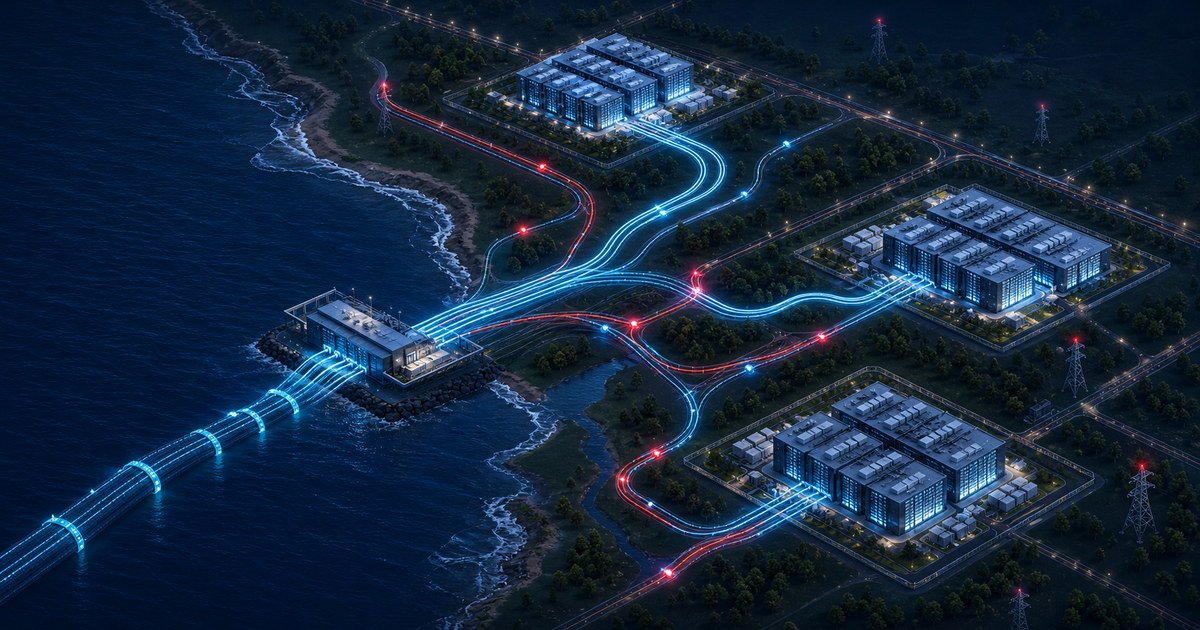
Two recent announcements illustrate different layers of the connectivity stack. Ciena and CtrlS said they are building five metro optical networks linking nine CtrlS data centres across five Indian cities, with up to 100 Tb/s of network capacity for a hyperscaler deployment. Google’s February 2026 America-India Connect announcement describes a planned subsea gateway at Visakhapatnam and additional international routes connecting India with Singapore, South Africa and Australia. These are network projects and plans—not proof that every data centre on those routes has direct access, or that all announced cables are already commissioned.
For operators, investors and enterprise buyers, the diligence question is therefore not “Is there fibre nearby?” It is: how many physically diverse paths reach the building, who controls them, what latency and bandwidth are committed, which interconnection points are accessible, how quickly can the service scale, and what happens when one route fails?
Contents
- The survey signal: important, but not a new universal rule
- What data-centre connectivity actually includes
- Why connectivity can influence site choice
- India examples: metro fibre and international cable routes
- A practical connectivity checklist for site selection
- Power and fibre are complements, not substitutes
- What this could mean for established and emerging hubs
- Questions to ask before signing a site or network agreement
- Frequently asked questions
- Related Gridvik research
- Sources and research note
The survey signal: important, but not a new universal rule
Moneycontrol’s 8 October report says a preliminary CBRE 2026 India Data Centre Operator Survey found that network connectivity was identified as a key consideration by 75% of surveyed operators, compared with 67% for power availability. The same report lists proximity to clients at 58% and land cost at 50%. It also reports that more than 90% of surveyed operators maintained a presence in both Mumbai and Chennai.
| Factor reported in the survey coverage | Share of surveyed operators identifying it | Cautious interpretation |
|---|---|---|
| Network connectivity | 75% | Connectivity was frequently cited in this survey; the public summary does not define whether it means fibre access, carrier diversity, interconnection or a broader network bundle. |
| Power availability | 67% | Power remains a leading site factor. The percentage is not evidence that power constraints are solved. |
| Proximity to clients | 58% | Customer and workload geography can influence the preferred location. |
| Land cost | 50% | Cost matters alongside the infrastructure and market-access factors. |
The figures are not necessarily mutually exclusive. If respondents could choose multiple factors, 75% and 67% are not two sides of a single vote. Nor does a higher share of respondents identifying one factor mean that it is more expensive, more difficult to secure or more critical for every project.
There is another limitation: the public story summarising the preliminary survey does not state the number of respondents, the exact wording, response options, weighting, or the regional composition of the sample. Without those details, readers should treat the result as directional evidence about participating operators—not as a census of the Indian market.
The useful takeaway is narrower and still valuable: site-selection conversations should explicitly score network access rather than treating it as a late-stage telecom add-on. A project can have adequate headline power and still be commercially weak if its paths to customers, clouds, exchanges or other campuses are slow, costly or vulnerable to one physical failure.
What data-centre connectivity actually includes
“Fibre is available” is not a sufficient network specification. A data centre’s connectivity is made up of multiple layers, each with different routes, owners, latency and failure modes.
1. Inside the building and across the campus
Inside a facility, the network connects servers, storage, security systems, management platforms and customer cross-connects. AI clusters can require high-throughput, low-latency communication among accelerators; the exact design depends on the workload and hardware. Campus links may connect multiple buildings or shared infrastructure. A building with spare carrier ducts is not automatically ready for a large AI cluster if its internal network design, equipment and operational support are not suitable.
2. Metro connectivity and data-centre interconnect
Metro fibre links a data centre to other facilities, cloud on-ramps, internet exchanges, enterprise locations and carrier hotels in the same urban region. This layer supports replication, backup, disaster recovery, live migration, content delivery and interconnection between cloud or colocation sites.
For a multi-site operator or customer, metro distance is only one input. A route may take a circuitous path through shared ducts, cross congested segments or depend on the same bridge, tunnel or utility corridor as a supposedly separate backup. A route diagram should show the physical path, not only the provider name.
3. National long-haul and international subsea routes
Long-haul networks connect metro markets across the country. Subsea cables connect coastal landing stations to international networks. A campus near a landing station may have a strategic advantage, but proximity alone does not guarantee access: the site still needs terrestrial backhaul, capacity, commercial agreements, landing-station access, permits and onward routes.
Network service can be measured in several ways. Bandwidth describes the capacity of a link or service; latency describes the time for traffic to travel; availability describes how often a service is usable under a defined measurement; and route diversity describes whether backup paths avoid common physical points of failure. One metric cannot substitute for the others.
4. Interconnection and ecosystem access
Carrier-neutral facilities, internet exchanges and cloud on-ramps can make it easier to connect to multiple networks or services without building a dedicated long-haul link to each provider. Interconnection can affect latency, cost, operational complexity and resilience. Buyers should verify which carriers and exchanges are physically present, whether cross-connects are orderable, and what delivery lead times apply.
A marketing phrase such as “multi-carrier” does not prove diversity. Multiple retail providers may lease the same underlying fibre route. Ask for physical route maps or an attestation that discloses shared ducts, meet-me rooms, building entrances and common intermediate points.
Why connectivity can influence site choice
Latency and customer experience
Financial services, interactive applications, real-time analytics, gaming, collaboration and some inference workloads are sensitive to the time data takes to travel. Locating compute nearer to users or connected services can reduce round-trip delay, but actual latency depends on the path, routing, congestion, network equipment and peering—not just the straight-line distance between two cities.
A site-selection exercise should test latency from the proposed campus to the actual customer locations, cloud regions, internet exchanges and partner systems. A generic “connected to Mumbai” statement does not answer the requirement for a particular application.
Resilience and continuity
Connectivity is part of a data-centre’s continuity plan. If two links share one duct, landing station, bridge crossing or upstream network, a single physical event may disrupt both. Diverse routes can improve resilience, but only if they are genuinely independent and the customer’s own routing and failover are configured to use them.
Diversity has a cost. The second route may require separate rights of way, different carriers, additional cross-connects, more equipment and recurring charges. A buyer should compare the expected reduction in outage risk with the service’s resilience requirements and the cost of alternative architecture.
AI and cloud workloads
AI facilities have at least two network problems to solve. Inside a cluster, accelerators may exchange large volumes of data over a specialised fabric. Outside the cluster, users, datasets, storage, cloud services and other campuses need external connectivity. A city-level fibre route does not prove that the inter-rack fabric is ready; a fast GPU fabric does not guarantee adequate wide-area service to customers.
As AI inference is distributed across more applications and locations, operators may need flexible metro and long-haul connectivity. Training, inference and data movement can place different demands on the network. The workload owner should model the pattern rather than infer a required bandwidth from a single announced campus MW figure.
Customer proximity and ecosystem
The CBRE survey coverage also reports that 58% of respondents identified proximity to clients as a site factor. This reinforces the value of demand geography: a site may be attractive because it is near enterprise users, a cloud region, an exchange, a subsea gateway or another data-centre cluster. Those advantages may overlap, but they are not identical.
The right location depends on the service. A hyperscale build serving national or international traffic may prioritise backbone routes and power economics. An edge site serving a city-specific application may place more weight on local latency. A disaster-recovery site may be selected partly to avoid common hazards and infrastructure dependencies.
India examples: metro fibre and international cable routes
CtrlS and Ciena: metro optical networks across five cities
On 28 September 2026, Ciena announced that CtrlS Datacenters was working with it to build five metro networks connecting nine CtrlS data centres across Chennai, Hyderabad, Kolkata, New Delhi and Noida. Ciena says the managed optical-fibre network deployment is intended for a leading hyperscaler and can deliver up to 100 Tb/s of capacity.
This is an example of the metro layer: several data centres connected within city markets, supporting a hyperscaler network requirement. The 100 Tb/s figure is the stated capacity of the optical network deployment—not 100 Tb/s of internet service for every tenant, not 100 MW of data-centre IT load and not proof that every connection is already live. The release is from a technology vendor and should be attributed accordingly.
Google’s America-India Connect: announced international routes
Google’s 18 February 2026 announcement describes America-India Connect, including a planned international subsea gateway at Visakhapatnam, three new subsea paths connecting India to Singapore, South Africa and Australia, and additional fibre routes intended to improve resilience between the United States, India and locations across the Southern Hemisphere. The announcement describes routes associated with both Vizag and Mumbai.
The network case is about more than raw capacity. A new landing point can diversify international entry and exit paths and reduce dependence on a small number of coastal gateways. Yet the announcement is still a company plan. It does not, by itself, establish that every route is commissioned, that a particular data centre can buy capacity on it, or that the route has a stated end-to-end service level.
Karnataka’s coastal opportunity
Karnataka’s new Sustainable Data Centre Policy identifies regional development beyond Bengaluru and reporting discusses Mangaluru’s potential for cable-landing infrastructure. That is an opportunity to evaluate, not proof that a cable landing station is built or that a data-centre campus has international route diversity today. Our Karnataka policy guide separates policy intent from operating infrastructure.
For each network announcement, keep three fields separate: what is being built or planned; who has rights to use it; and which services are commercially available at the relevant site. This simple discipline prevents a cable route or metro-network project from being counted as a campus connection before the customer can actually order it.
A practical connectivity checklist for site selection
A site comparison should ask for evidence in at least eight areas. The answers belong in the same diligence file as power, land and water—not in a marketing appendix.
| Diligence area | Ask for | Red flag |
|---|---|---|
| Physical route diversity | Route maps showing ducts, entrances, intermediate points, bridges/tunnels and shared infrastructure | Two carrier names but a single underlying duct or building entrance |
| Carrier choice | Current carrier list, service availability, order process and expected delivery lead time | “Carrier-neutral” claim with no orderable services or cross-connect process |
| Latency | Measured or contractually defined latency to actual customer, exchange, cloud and recovery locations | Generic latency promises with no endpoints, test window or measurement method |
| Capacity and upgrade path | Available bandwidth, wavelength options, scalable increments and upgrade lead time | Capacity figure with no committed upgrade path or congestion information |
| Interconnection | Meet-me room, exchange, cloud on-ramp and cross-connect access, with fees and lead times | Site is “connected” only through one distant handoff or an unpriced extension |
| Failure and repair | Outage history where available, service-level terms, repair responsibility, restoration targets and escalation contacts | Redundant link relies on the same landing station, conduit or upstream carrier |
| International access | Landing station, backhaul owner, capacity rights, landing/telecom permissions and service availability | “Near a cable” presented as direct international connectivity |
| Governance and wayleaves | Rights of way, duct ownership, permits, utility coordination and change-control responsibilities | Route depends on unconfirmed access or another party’s future works |
For an AI campus, add the data-hall network design, inter-building capacity, cluster fabric responsibility, optical hand-offs, synchronisation requirements and the path between compute, storage and customer-facing services. Ask who pays for each layer and who restores it after an incident.
A useful contract should make it possible to tell a planned link from a lit service. It should state the endpoints, demarcation points, bandwidth, latency/availability measurements, maintenance notice, failover behavior, credits or remedies, upgrade options and incident reporting. “Low latency,” “resilient” and “high capacity” are not measurable service terms unless the contract defines them.
Power and fibre are complements, not substitutes
The survey finding should not be used to argue that electricity has become secondary. Connectivity can be the more frequently mentioned factor in one survey and power can still be a binding constraint for a project. A site needs a deliverable electrical connection and a workable network design at the same time. If either arrives late, the campus may not meet its service date.
It is also possible for the two constraints to interact. Network equipment, optical systems, cooling, UPS and redundancy all need power. The site’s power upgrade may affect the schedule for switching and transmission equipment. A remote fibre route can make it harder or more expensive to serve certain customer markets. A customer may need more than one building or campus to achieve resilience, which changes both energy and connectivity demand.
A balanced site scorecard can track separate evidence fields instead of creating a single opaque “readiness score”:
- Power: available and committed MW by phase, connection agreement, upgrade scope, energisation date, tariff and backup design.
- Fibre: number of physically diverse routes, provider options, capacity available today, upgrade time and testable latency to key endpoints.
- Water and cooling: verified source, seasonal availability, treatment, reuse, cooling design and local conditions.
- Land and approvals: title, permits, access, construction readiness and environmental risks.
- Market access: customer footprint, interconnection ecosystem, cloud reach and workforce.
Gridvik’s power and policy guide covers the electrical side; this article adds the network evidence that should sit beside it. Neither a statewide generation number nor a nearby fibre line proves that a particular building has a deliverable connection.
What this could mean for established and emerging hubs
Moneycontrol’s report says more than 90% of surveyed operators maintained a presence in both Mumbai and Chennai. It also cites Mumbai’s and Chennai’s subsea-cable infrastructure and reports that more than 80% of existing capacity remained concentrated in markets such as Mumbai, Chennai and Delhi-NCR. These are findings reported from the survey—not a complete site-by-site inventory.
The established hubs have a dense ecosystem of customers, carriers, cable landings and data-centre operators. That density can lower the effort needed to interconnect, but it can also concentrate infrastructure dependencies and competition for land, power and routes. A cluster advantage is not the same as unlimited utility capacity.
Emerging markets such as Hyderabad, Bengaluru, Kolkata and Visakhapatnam may offer their own combinations of land, customers, power, water, policy support and network access. They should not be treated as interchangeable “Tier II” alternatives. Each requires a route and latency analysis for the buyer’s actual workload. A city with a planned cable gateway may be attractive for international traffic, but a campus several hundred kilometres inland still needs dependable terrestrial paths to that gateway and onward to customers.
For a distributed portfolio, a second city can add resilience only if it has different failure domains. Compare grid regions, flood and heat risks, water basins, subsea landings, long-haul corridors, cloud regions and repair logistics. Geographic separation without infrastructure independence can create the appearance of resilience while leaving shared points of failure untouched.
Questions to ask before signing a site or network agreement
For a data-centre developer
- Which networks are physically present at the site today, and which are only planned?
- Can at least two routes enter the campus through separate ducts and building points?
- Who owns or leases each fibre segment, and who can approve repairs or route changes?
- What capacity is immediately orderable, and what is the lead time for expansion?
- Are there documented outages or common points of failure on the route?
- Is there access to neutral interconnection, cloud on-ramps and exchanges?
For a hyperscaler or enterprise buyer
- Where are users, data, cloud regions, exchanges and recovery systems located?
- What latency and availability does the application require, and how will it be measured?
- Does the network provider’s SLA cover the entire end-to-end path or only one segment?
- Does a second link fail over automatically, and has that process been tested?
- What are the recurring and one-time charges for cross-connects, wavelengths, capacity upgrades and route extensions?
- Does the site’s data-residency or security design require any specific carrier or route?
For an investor or analyst
- Is the reported fibre route commissioned, under construction, announced or merely proposed?
- Is the capacity a network-system headline, a contracted customer service or a serviceable campus connection?
- Does the project name the end user or only the network provider?
- Are capacity figures overlapping with a separate campus or operator announcement?
- What evidence would change the project status in the ledger?
These questions turn “connectivity” from a vague siting advantage into a set of evidence-backed variables that can be compared across sites.
Frequently asked questions
Does the CBRE survey prove that fibre is more important than power in India?
No. Moneycontrol reports that 75% of surveyed operators identified network connectivity and 67% identified power availability as site-selection factors. The public summary does not disclose the sample size or question method, and the percentages may not be mutually exclusive. The finding is a directional signal, not a universal rule.
Is network connectivity the same as fibre availability?
No. Fibre is one part of connectivity. Route diversity, carrier choice, interconnection, bandwidth, latency, network operations, service terms and international access also matter. A site may have a fibre line nearby but no orderable, diverse service to the required endpoints.
Does Google’s America-India Connect mean the Vizag routes are operational?
Google’s February 2026 announcement describes a planned gateway and new routes. The announcement is evidence of a plan, not evidence that all components have been commissioned or that a particular data centre can order capacity on them. Check for later commissioning and service-availability notices before describing a route as live.
What does “up to 100 Tb/s” mean in the CtrlS–Ciena announcement?
Ciena describes up to 100 Tb/s for five planned metro optical networks connecting nine CtrlS data centres across five cities, for a hyperscaler network deployment. It is not a data-centre power figure and should not be presented as a service that every tenant can use.
Do data centres need to be next to a subsea cable landing station?
Not necessarily. A campus may connect to an international gateway over terrestrial long-haul fibre. The right location depends on customer latency, route diversity, capacity, price, permitting, power, land and resilience. Proximity can help, but it does not replace end-to-end network design.
How many independent fibre routes are enough?
There is no single number that fits every workload. The important point is whether routes are physically diverse, independently operable and sized for the service’s recovery objectives. Ask for route diagrams, common-risk analysis and tested failover—not just the number of carriers.
Related Gridvik research
- Karnataka’s Sustainable Data Centre Policy 2026–2031
- CoreWeave’s planned 240 MW India AI campus
- India’s data-centre power bottleneck and grid readiness
- India’s data-centre expansion: capacity, cities and AI
- India data-centre investment map
Sources and research note
Research checked 10 October 2026. The survey percentages below are attributed to Moneycontrol’s report on a preliminary CBRE survey; the full CBRE survey methodology was not available in the public summary we reviewed. The network examples are attributed to the companies announcing them and should be treated as company-reported projects or plans, not independent commissioning evidence.
- Moneycontrol — “Network connectivity pips power in selection of data centre sites: CBRE,” 8 October 2026
- Ciena — CtrlS metro optical-fibre network announcement, 28 September 2026
- Google — America-India Connect announcement, 18 February 2026
- The Hindu — Karnataka’s Sustainable Data Centre Policy and regional development, 18 September 2026
Gridvik is an independent research firm. This article is informational and is not engineering, investment, legal, procurement, telecom or financial advice. Announced network projects may change; verify end-to-end serviceability, route diversity and commissioning status with the provider before making a site or purchasing decision.