
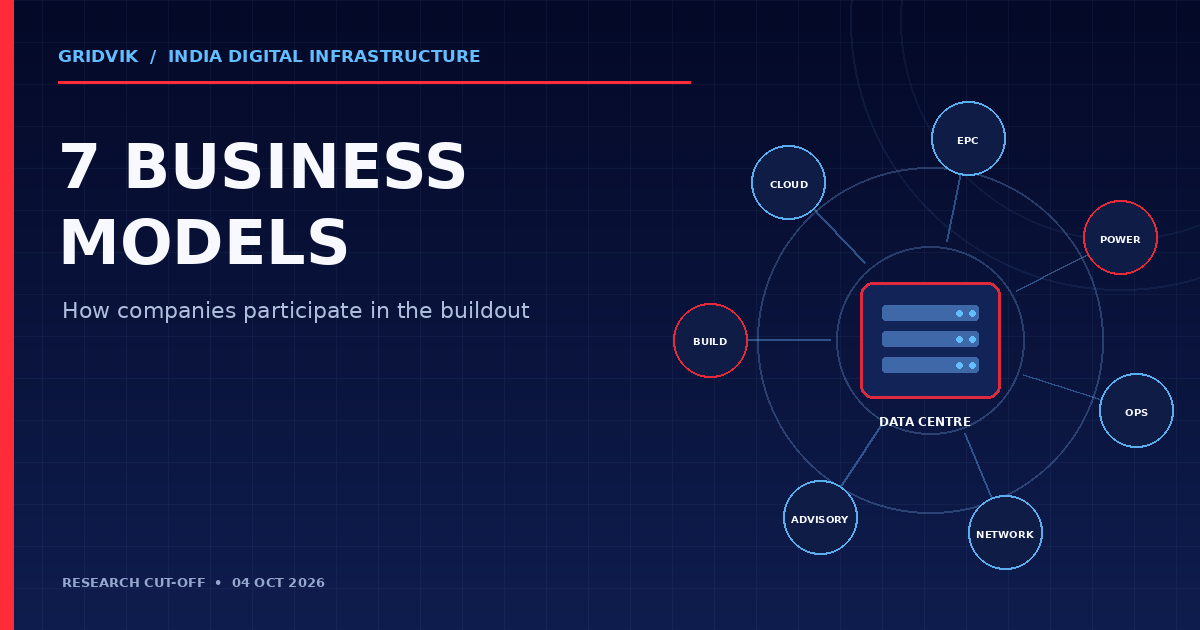
Quick answer: Companies can participate by developing or operating capacity, selling cloud and AI services, building facilities, supplying power or cooling, providing software and operations, delivering connectivity and security, or selling specialist advisory and research. The model that fits depends on the company’s capital, technical qualifications, customer access and ability to deliver. There are real opportunities, but no “proven profit” or guaranteed margin applies to every company.
Research note: This is a business-model guide, not an investment recommendation. Announced plans, MoUs, under-construction phases and live facilities are identified separately. Commercial examples show market activity; they do not prove that another company can copy the same economics.
In this guide
- Start with the customer and the revenue event
- Seven ways companies can participate
- Model 1: Develop, own or operate capacity
- Model 2: Sell cloud, AI and managed compute
- Model 3: Build, design and commission facilities
- Model 4: Supply power, cooling and water systems
- Model 5: Provide software and recurring operations
- Model 6: Sell connectivity, security and resilience
- Model 7: Provide finance, advisory and market intelligence
- Compare models by capital, risk and time to revenue
- A practical go-to-market plan for a small or mid-sized company
- How to qualify an opportunity before you spend
- Match the model to the company’s starting position
- Build a sales pipeline that reflects evidence
- Related Gridvik guides
- Frequently asked questions
- Sources and further reading
Start with the customer and the revenue event
“Make money from data centres” sounds like one question, but it is really several. A company might own an asset, sell construction work, supply a system, provide a managed service, or sell computing capacity. Each requires a different buyer, contract, delivery capability and balance sheet. The first task is to choose the part of the value chain where the company has an advantage—not to chase every project headline.
A useful way to describe any opportunity is with five fields:
- Buyer: operator, cloud provider, developer, tenant, utility, EPC, government agency or service partner.
- Product: capacity, construction scope, equipment, software, electricity, network access, operations or specialist advice.
- Buying trigger: approved design, land and power readiness, tender, purchase order, site handover, facility launch or customer usage.
- Revenue event: deposit, milestone invoice, equipment delivery, commissioning acceptance, subscription renewal or monthly usage.
- Risk: customer demand, price, working capital, certification, schedule, power, service-level exposure or capital intensity.
A press release may tell you the buyer’s broad ambition, but it often does not answer these five questions. A project may be announced at gigawatt scale yet have only an initial phase in design. A company may state a national investment commitment that includes cloud operations, skills and other activities. A state policy may offer an incentive but require an eligibility threshold, approval and reporting. A vendor should not hire a large team or buy long-lead inventory on the basis of a headline alone.
A second important distinction is revenue versus profit. A contract can increase revenue while reducing profit if the supplier has underestimated installation cost, financing, warranty, logistics, tax or service obligations. A facility can show high contracted demand while still requiring years of spending before it reaches stable operations. A cloud company can earn high recurring revenue but also incur significant hardware, software, network and energy costs. The business model must work after costs and capital—not just in an announcement table.
The seven models below are designed to help a company select a route. They include high-capital strategies such as owning a data-centre platform and lower-capital strategies such as maintenance, software or specialised engineering. The sections describe where to look, what buyers care about and how to reduce avoidable risk. They do not publish invented project margins, guaranteed order sizes or universal procurement dates.
Seven ways companies can participate
| Model | What the company sells | Typical buyer | Capital intensity | Revenue pattern |
|---|---|---|---|---|
| 1. Develop / own / operate | Data-centre capacity and related services | Cloud provider, enterprise, hyperscaler, colocation tenant | Very high | Long-term capacity and service contracts, phased ramp |
| 2. Cloud / AI / compute | Compute, storage, AI, software and managed services | Businesses, government, developers and consumers | High to very high | Consumption, subscription, reserved capacity, support |
| 3. Build / design / commission | Civil, electrical, mechanical, controls, project delivery | Developer, operator, EPC, owner | Medium to high | Project milestones, fixed price or measured work |
| 4. Power / cooling / water | Equipment, energy, storage, cooling and water systems | Operator, EPC, utility, renewable buyer | Medium to high | Equipment sale, project scope, long-term energy or service contract |
| 5. Software / operations | Monitoring, maintenance, security, compliance and efficiency | Operator, owner, cloud platform, enterprise | Low to medium, depending on product | Subscription, service contract, licence or support |
| 6. Connectivity / resilience | Fibre, interconnection, network, backup and security | Operator, cloud provider, tenant, carrier | Medium to high | Recurring capacity and service charges, installation |
| 7. Finance / advisory / intelligence | Capital, due diligence, design, legal or public-source research | Developer, fund, lender, operator, vendor | Low to very high | Interest, fees, retainers, subscriptions or mandates |
“Capital intensity” is relative. A cloud-services startup may not build a facility, but it can still need expensive compute, sales, compliance and engineering. A maintenance provider may need much less capital than a developer, but still needs trained staff, insurance, tools and spare parts. The table is a first filter, not a complete financial model.
Model 1: Develop, own or operate capacity
What the model is
A developer secures a site and coordinates land, power, approvals, design, construction, finance and potential tenants. An owner holds the asset and earns from rent, capacity contracts or asset appreciation. An operator runs the facility, delivers service levels, monitors systems and maintains the building. Some firms combine these roles; others use joint ventures or third-party operators.
The customer may be a hyperscaler, cloud provider, enterprise, telecom company, AI platform, government agency or other operator. The customer may lease a dedicated building, a suite, racks or a defined amount of IT load. The agreement can include power, cross-connects, security, remote hands, service levels and options to expand. Different contracts allocate risks differently, so “colocation” is not one uniform product.
Where the revenue comes from
Potential revenue streams include recurring rent or capacity charges, one-time installation fees, interconnection charges, managed services and power-related pass-throughs. The revenue model is usually tied to specific contracted capacity and operational performance. It may ramp over time as phases open and customers deploy servers. Developers may earn through development fees, joint-venture interests or a sale of a completed asset; owners may receive recurring cash flow; operators may earn service revenue.
The important question is who books which revenue. A company that builds a facility for a customer may earn construction revenue but not the recurring rent. A landlord may own the building but outsource day-to-day operations. A cloud company may consume capacity and sell services without owning the real-estate asset. A press release naming several partners does not disclose each participant’s capital contribution or profit share.
What a new entrant must prove
Developing capacity is a high-capital, multi-year undertaking. Before committing, a developer must prove that the parcel can be used for the project; that utilities, power and network routes can be delivered; that the design meets the target customers’ requirements; that financing is available; and that the company has a credible construction and operations plan. A customer pre-lease or clear demand evidence can materially change risk, but it still needs legal and technical diligence.
A smaller company can enter this model indirectly. It can build a smaller colocation site, operate a specialised facility, provide a local operating service, or become a joint-venture partner with a defined capability. It should not assume that “small scale” removes the need for redundancy, security, compliance, power and service quality. A lower-capacity facility can still be mission-critical to customers.
Public examples—and what they do not prove
Google says its Visakhapatnam AI hub programme involves US$15 billion over 2026–2030 and gigawatt-scale data-centre operations together with energy and fibre infrastructure. Google announced a groundbreaking in April 2026. This is a public example of a hyperscaler-led campus programme and partner ecosystem; it is not evidence that every supplier has a signed order or that the full programme is operational.
Digital Connexion, the joint venture of Brookfield, Reliance and Digital Realty, announced an US$11 billion plan for a 1 GW campus in Visakhapatnam by 2030 through an MoU with Andhra Pradesh. Its scale shows the type of capital a large, phased campus may require. It remains important to track phase and delivery evidence separately from the long-term plan.
Meta and Reliance announced an agreement for Meta to lease capacity at a 168 MW AI-enabled facility in Jamnagar, with options to scale. The agreement describes a build-to-suit relationship and identifies a customer, but the amount of project capex was not disclosed in the announcement. Do not infer the project’s cost or return from the MW figure.
How to test the model
- Confirm the owner, operator, developer and customer separately.
- Identify whether the quoted MW is IT load, utility load or long-term campus potential.
- Separate land control, approvals, funding, construction and live status.
- Confirm customer contract duration, volume, power treatment and termination rights.
- Model development capex, interest during construction, phase timing and occupancy ramp.
- Stress-test delayed grid availability, lower take-up and higher construction costs.
- Confirm the organisation can operate the facility after construction—not just build it.
This model can be attractive when a developer assembles land, power, customer demand, financing and delivery capability effectively. It can be destructive to capital when a large site is built ahead of demand or lacks a credible power path. The word “platform” does not make the project self-funding; each phase still needs capital and customer evidence.
Model 2: Sell cloud, AI and managed compute
What the model is
Cloud providers and AI platforms convert physical infrastructure into digital services. Customers pay for compute, storage, data services, AI model access, databases, networking, security and managed platforms. A business may build its own software layer, sell through a hyperscaler marketplace, act as a cloud reseller or provide managed services around another provider’s infrastructure.
The company does not necessarily own the data centre. It may rent capacity from an operator or use a cloud region. This can reduce the need to build a facility but does not make the business cost-free. Compute, accelerators, network, software licences, data storage, security, technical support and customer acquisition all affect unit economics.
Ways to earn
A cloud or AI company can charge by consumption, subscription, reserved capacity, per-user licence, managed-service retainer, implementation fee or support contract. Some products combine a platform fee with usage-based compute. A reseller may earn a discount or service fee; a software vendor may earn a recurring licence; a managed-service provider may earn for operating the customer’s cloud environment.
The provider should measure gross margin per workload or customer, not only top-line revenue. The cost of inference, storage, data movement, GPU time, support, security and billing disputes can vary substantially by workload. If a company promises unlimited use at a fixed price, it needs to understand peak usage and the cost of serving it.
What the India buildout changes
New cloud regions and hyperscale investment can create demand for cloud migration, AI enablement, security, data management, application modernisation, training and support. Microsoft announced US$17.5 billion over 2026–2029 for India’s cloud and AI infrastructure, skills and operations, building on an earlier US$3 billion announcement. Its India South Central region in Hyderabad became an operational cloud region in 2026, according to Microsoft. These facts indicate a larger ecosystem, but they do not imply that every local partner is an approved vendor or that every cloud project requires a new data-centre build.
AWS describes its US$12.7 billion India cloud-infrastructure plan by 2030 and a separate US$8.3 billion Maharashtra plan as part of that earlier national plan. That is a useful example of state-level infrastructure investment connected to a broader cloud strategy. Amazon’s broader 2025 and 2026 India announcements include activities beyond data centres, so they should not be added mechanically to AWS’s earlier amounts.
Entry path for a smaller technology firm
A startup can focus on one job that customers already need: secure cloud migration, cost optimisation, backup and recovery, data governance, GPU scheduling, model deployment, observability, AI workflow integration, or managed compliance. The product should solve a measurable problem for a named user, such as reducing a defined cloud bill, lowering deployment time, improving recovery testing or making a workload easier to audit.
A practical entry path is to:
- Select a narrow customer and workload rather than “all AI workloads.”
- Identify the budget owner and integration environment.
- Build a small proof-of-value using the customer’s own baseline.
- Pass security, privacy, procurement and technical review.
- Convert the pilot into a paid recurring contract with clear usage limits.
- Track consumption cost, support time, churn and expansion revenue.
A common mistake is pitching “AI demand” without explaining which user pays, what is automated and how the service performs under production load. Another is using free cloud credits as a substitute for a margin model. Credits may help with a pilot but can expire; a real business should know what happens when the customer begins paying for compute.
What to test before hiring or building
- Is the product differentiated or a thin wrapper around a cloud provider’s feature?
- Does it handle sensitive data, customer identity and access controls safely?
- Can the product run in the customer’s required region or on an approved cloud?
- What is the gross margin at high usage, not just in a demo?
- Does the customer have budget, procurement authority and a production deadline?
- Can the team support incidents outside standard business hours?
- Is the revenue recurring, usage-based, project-based or a mixture?
A cloud business can scale beyond the physical facility, but it must earn trust and keep service economics under control. The arrival of a new data centre is a market signal; the product still has to win customers.
Model 3: Build, design and commission facilities
What the model is
This model includes architecture, engineering, project management, civil construction, electrical and mechanical works, controls, safety, commissioning and fit-out. A company may be a prime contractor, a specialist subcontractor, a design consultant, a commissioning agent, an equipment installer or a project-management firm.
Data-centre work has specialised requirements: redundancy, resilience, safety, testing, change control, documentation and acceptance. The buyer may be the owner, developer, operator, EPC contractor or an appointed consultant. Procurement could be direct or through a chain of contractors. The path to revenue depends on the contractual arrangement and the delivery milestones.
How companies earn
A contractor may earn fixed-price project revenue, cost-plus fees, milestone payments, design fees, project-management fees, installation charges or commissioning fees. A maintenance contract can extend the relationship after handover. A design firm may work early in the project, while construction and commissioning contractors enter later.
Revenue is linked to scope and progress; profit is affected by productivity, changes, procurement and risk allocation. A fixed price can be attractive if the scope is stable and risks are understood. It can be dangerous if the design is incomplete, site conditions are unknown or the contract pushes power and equipment risk onto the contractor. A lower bid is not automatically a winning business model.
Qualification and proof
A vendor should assemble evidence of relevant project experience, quality systems, safety procedures, staff certifications, insurance, financial strength and service capability. Buyers may request pre-qualification, technical submittals, reference projects, factory testing, commissioning plans, cybersecurity review and local support. Requirements vary, so a company should study actual tenders and buyer documents rather than rely on generic claims.
Local presence matters. A supplier that can respond quickly to a site, keep spare parts nearby and coordinate with the project manager may have an advantage over a distant competitor. But expansion into a new city requires working capital and a trained team. The company should estimate travel, accommodation, hiring, tooling, safety training and the cost of leaving work crews idle between phases.
How to pursue projects responsibly
A vendor should map the relationship between the operator, developer, EPC, consultant and equipment OEM. The party that announces a project may not issue the purchase order. A contractor may need to identify the procurement entity, subcontracting route, specification authority and payment source. The seller should not misrepresent access to a buyer or claim a project is “ready to order” when public evidence shows only an MoU.
Develop a project pursuit plan with: named account; official company page; source date; project phase; likely package; qualification status; expected decision gate; next action; budget confidence; and the reason to stop pursuing. The plan should include a revalidation date, since construction schedules can change. If a project is not public enough to identify a procurement route, label it as an early lead rather than a forecasted order.
The contract checklist
Before accepting scope, confirm:
- Exact drawings, specifications and responsibility matrix.
- Scope boundaries, exclusions and dependencies on other contractors.
- Site access, permits, safety and environmental conditions.
- Currency, taxes, escalation, delivery and payment terms.
- Testing, commissioning, acceptance criteria and documentation.
- Change-order process and how design changes are priced.
- Warranty, service levels, liquidated damages and liability caps.
- Retention, performance bonds, insurance and dispute resolution.
A contractor can create value by making complex delivery predictable. The “profit model” is not simply a percentage of a huge capex announcement. It is the difference between a well-understood scope and the full cost of delivering it under the contract.
Model 4: Supply power, cooling and water systems
What the model is
This category includes generators, UPS, transformers, switchgear, power distribution, substations, batteries, renewable-energy projects, cooling systems, chillers, pumps, liquid-cooling loops, water treatment, monitoring and efficiency services. A company may manufacture equipment, integrate a system, build energy infrastructure, sell power under a contract or provide operation and maintenance.
Power, cooling and water are not optional accessories. They determine whether a facility can operate reliably, what workloads it can support and how much it costs to run. AI-ready facilities can have different rack densities and cooling needs from traditional enterprise rooms. The right solution should be selected for the planned workload and design, not because one technology is currently in the news.
Revenue types
- Equipment sale and installation.
- Engineering and integration fees.
- Long-term power or renewable-energy supply agreements.
- Storage or backup-power service.
- Maintenance, monitoring and replacement parts.
- Water treatment, recycling, desalination or monitoring services.
- Efficiency projects paid through a fixed fee or performance-linked contract.
Each has a different risk. Equipment vendors face supply chain, warranty and price competition; energy suppliers face generation, grid, contract and regulatory risks; system integrators face delivery and coordination risk; service providers face uptime obligations and skilled-labour needs.
The grid and the “firm power” question
A site’s proximity to generation does not prove it can receive the required power at the right node, voltage, redundancy and date. A project must coordinate with utilities, transmission providers, regulators and construction teams. It may need new substations, transmission lines, redundant feeders or backup systems. The company should distinguish a state-level power target from an approved connection for the project.
A renewable contract also needs careful interpretation. Nameplate MWp, annual MWh, round-the-clock matching and firm supply are different metrics. A solar plant may provide energy when the sun shines but not a continuous data-centre load without storage, grid balancing or other generation. A provider should disclose how the contract is shaped and what happens under curtailment, transmission delay or a shortfall.
Cooling and water solutions
A cooling provider can help a facility meet design temperatures, manage heat density and reduce energy use. But efficiency claims should state the baseline and measurement method. A solution that works for one rack density or climate may not suit another. Liquid cooling may be relevant for certain AI or high-density workloads, but it brings design, maintenance, water quality and operating considerations. Air systems remain relevant in many contexts; the design should match the load and operator’s capability.
Water matters beyond cooling. The project needs an approved source, treatment and discharge plan. A developer may use recycled water, closed-loop systems or desalinated water where suitable. Meta’s Jamnagar announcement says the facility will be powered by renewable energy and cooled with desalinated seawater, with Meta covering energy and water costs. This is a specific public project description, not evidence that desalination is the right solution for every state or campus.
How to qualify a supplier opportunity
- Identify whether the specification is settled and who controls it.
- Confirm whether the project is actually in the relevant state and phase.
- Understand the load, redundancy, voltage, cooling, water and monitoring requirements.
- Verify the project’s utility connection and contract scope.
- Check the approved-vendor route, performance tests and certifications.
- Model commissioning, warranty, spares, service support and currency risk.
- Never quote an expected order date as fact unless a source or buyer confirms it.
A company that reduces project risk can win repeat business. A company that promises “green” or “AI-ready” without a verifiable technical scope may lose trust. The best sales case is usually a measured operational improvement tied to reliability, cost, water or time.
Model 5: Provide software and recurring operations
What the model is
Facilities need software and people to monitor equipment, maintain assets, manage alarms, record changes, track energy, secure access, schedule work and comply with customer and regulator requirements. Software vendors may sell building-management, data-centre-infrastructure-management, security, asset-management, workflow, predictive-maintenance or energy-monitoring tools. Service firms may provide remote monitoring, facility operations, maintenance, compliance support or specialist training.
This model can be less capital-intensive than building a campus, but it is not “easy money.” Customers expect reliability, integration with existing systems, data security, strong support, auditability and low operational risk. A data-centre operator may take months to approve software or a process change because a faulty update can affect a critical environment.
How recurring revenue works
A software firm may charge per facility, rack, asset, user, site, data point or module. A service firm may charge a monthly retainer, service tier, per-visit fee, labour rate or defined performance contract. A product can combine implementation fees with subscription revenue. The seller should understand the customer’s renewal cycle and what happens when a facility adds a new phase.
A strong recurring model measures retention, expansion, service cost and customer outcomes. A customer may stop paying if the tool creates more alarms than it resolves or requires repeated manual work. A maintenance contract can become unprofitable if response times, site travel or replacement parts were underpriced. A software provider should calculate cost to serve, not only subscription value.
High-value use cases
Potential use cases include tracking energy and cooling performance; improving asset inventory; coordinating planned maintenance; identifying abnormal equipment behaviour; managing change approvals; documenting commissioning; monitoring water; controlling access; testing backup and recovery; and preparing audit evidence. A use case has commercial value when it reduces a measurable pain for an operations or finance owner.
Before pitching predictive maintenance, a company needs data access, sufficient history, a clear fault definition and a process for acting on alerts. Before pitching energy optimisation, it needs a baseline and a method for separating weather, occupancy and workload changes from the product’s effect. Before pitching compliance tooling, it needs to understand the applicable standard and the customer’s evidence needs.
Pilot design
A good pilot is small enough to be safe and large enough to measure. Define the baseline, target metric, data owner, security review, change window, operating team and exit criteria. Record what happens if the system produces a false positive or misses a fault. Agree on who owns the data and whether the result can be published as a case study. If the value cannot be measured within a reasonable period, the sales team should explain why the pilot still matters.
For a small company, partner with an established operator or integrator rather than trying to enter every account alone. A strong partner can provide site knowledge and assurance, while the product company can focus on a narrow technical advantage. Make sure the commercial agreement defines support, data handling, intellectual property and customer ownership.
Model 6: Sell connectivity, security and resilience
What the model is
A data centre must connect to customers and networks, protect systems, and recover from failure. The opportunity includes fibre routes, cross-connects, dark fibre, internet transit, private circuits, network security, distributed denial-of-service protection, identity controls, backup connectivity, disaster recovery and business-continuity testing.
Connectivity can be sold by carriers, infrastructure owners, interconnection platforms, equipment vendors and managed-service providers. Security and resilience services may be sold by specialists, cloud partners or an operator’s own team. Some services are recurring; others are project-based or billed by port, bandwidth, site, incident or test.
What customers value
Customers may care about latency, resilience, route diversity, compliance, bandwidth growth, private connections, cloud on-ramps and service assurance. A route that looks redundant on a network diagram may share a physical duct or landing station. A buyer should ask how route diversity is achieved and tested, not only how many carriers are listed.
Security services must be tied to architecture and operating responsibilities. A provider should define which systems it monitors, who can approve changes, how incident escalation works, what logs are retained and how the service interacts with the customer’s security team. A data-centre operator may require vendors to pass security checks before receiving system access.
Network and subsea opportunities
Google’s official Visakhapatnam announcement includes a proposed new international subsea gateway and expanded fibre network as part of the AI hub. That makes connectivity a visible part of the broader investment programme. It does not mean every adjacent company will earn a contract. Suppliers need to know who owns the cable system, the landing station, terrestrial routes and customer-facing service, and what capacity is available.
A network firm can pursue an opportunity by mapping carriers, landing stations, interconnection points, terrestrial routes and customer demand. It should confirm build schedules, wayleaves, access rights, equipment availability and service-level commitments. A provider should avoid implying a cable route is operational until a source confirms it is ready for service.
Resilience as a service
Disaster-recovery planning, backup connectivity, failover tests and incident simulations can generate value without selling the building. A service provider can help a customer test whether an application can continue if one facility, route, power feed or cloud zone becomes unavailable. The company can charge for an assessment, remediation project or ongoing testing. The work must be specific to the customer’s architecture and risk tolerance.
A new market participant should begin with one network or security problem that can be demonstrated. Claims such as “five nines” or “fully secure” should be backed by the service’s scope, measurement period and contractual definition. Reliability is not a slogan; it is a design and operating practice.
Model 7: Provide finance, advisory and market intelligence
Finance and capital solutions
Data-centre projects can use corporate equity, joint-venture equity, project finance, construction debt, asset-backed facilities, green finance, customer pre-leases or sale-and-lease structures. The exact mix depends on the sponsor, asset, customer, market, lender and risk allocation. A financial institution may earn interest, arrangement fees, hedging revenue or advisory fees. An investor may earn cash yield or asset appreciation, but returns depend on the asset and contract.
A supplier can also help customers finance equipment through leasing, vendor finance or staged payments. That can reduce the buyer’s initial cash requirement, but it creates credit and residual-value risk for the supplier. The company should evaluate customer credit, collateral, asset life, maintenance and what happens if a project is cancelled.
Advisory and specialist services
Site selection, engineering, legal, tax, environmental, grid, water, energy and market-entry advice can be valuable where decisions are complex. An adviser may charge a fixed project fee, retainer, milestone fee or success fee, subject to applicable professional and conflict rules. The deliverable should answer a buyer’s specific question and use documented sources and assumptions.
A generic market report may be less valuable than a narrow deliverable: compare two candidate states; assess a public project pipeline; map public procurement notices; review a power agreement; test a lease-up sensitivity; or benchmark a proposed cooling design. The adviser should explain scope, limitations and what remains unverified.
Market intelligence as a product
A research firm can organise publicly available project, policy, power and timeline information into a structured product. A dataset may save a user time by linking a claim to its source, date and status. A weekly feed can help users monitor announcements and changes. The product should not pretend that public data is private access or that an estimated procurement window is a confirmed tender.
Gridvik, for example, describes its offering as independent public-source market research with a project tracker, policy matrix, power layer and estimated procurement windows. A user can inspect the free tracker sample, read the methodology page and compare available research services. A market-intelligence subscription is a tool for prioritisation; it cannot promise a contract or investment outcome.
How to make an advisory business repeatable
- Define the buyer and decision the service supports.
- Publish the methodology and evidence level.
- Separate public fact, company claim, forecast and analyst estimate.
- Offer a clear deliverable and delivery timeline.
- Keep a version history and last-verified date.
- Avoid claims of insider access, guaranteed returns or exact unpublished tenders.
- Reuse a structured process, not a generic report copied across clients.
Advisory can have lower capital requirements than asset ownership, but it relies on reputation, expertise, customer trust and repeat demand. It is not a shortcut around accuracy. In a market where project status can change quickly, an honest “not publicly disclosed” may be more valuable than an invented detail.
Compare models by capital, risk and time to revenue
A company should compare models using its own capability and balance sheet. “High opportunity” is not enough. The table below is a qualitative screen—not a ranking or a margin estimate.
| Model | Upfront capital | Route to first revenue | Core capability | Major risk to test |
|---|---|---|---|---|
| Develop / operate | Very high | After funding, build, commissioning and customer handover | Project finance, real estate, power, construction, operations | Unused capacity, power delay, cost of capital |
| Cloud / AI service | High, especially compute-dependent | Pilot, production deployment, usage or subscription | Software, security, sales, cloud/AI engineering | Compute costs, churn, customer adoption |
| EPC / construction | Medium to high | Contract award and milestone progress | Delivery, safety, quality, working capital | Fixed-price overrun and delay |
| Power / cooling / water | Medium to high | Equipment order or energy contract | Engineering, integration, approvals and service | Specification, long lead, warranty, grid risk |
| Software / operations | Low to medium | Paid pilot then recurring contract | Product reliability, integration and support | Long approval cycle and cost-to-serve |
| Connectivity / security | Medium | Installation, service activation and recurring use | Route design, telecom, security operations | Physical route diversity and service liability |
| Finance / advisory / research | Low for advisory; high for capital provider | Mandate, funding close, subscription or deliverable | Due diligence, data quality, credibility | Credit, conflict, stale data, scope creep |
Starting capital is not the only constraint
A small business may have enough capital for a product pilot but not enough sales access. A large company may have capital but lack a local operating team. A construction firm may have crews but no pre-qualification. A power developer may have generation assets but not the right node or contract. A consultant may have expertise but no repeatable route to market. The entry route should address the true constraint, not just the cash requirement.
Compare the time to first cash
Project developers often spend well before commissioning. Contractors may bill earlier but still face retention and collection delays. Software services can start with a pilot but may take months to pass security review. Cloud services can begin billing quickly once a customer uses the product, but the margin is sensitive to consumption. A long-term power agreement can create predictable revenue but relies on construction, grid and regulatory execution.
A business plan should show:
- Time from lead to signed contract.
- Time from signed contract to first invoice.
- Time from invoice to cash collected.
- Working capital needed while delivery is in progress.
- Exposure if the customer delays or cancels.
- Repeat revenue versus one-time project revenue.
The company should have enough cash to support the realistic route, including the downside case. If the business cannot survive a delayed first payment, it may need a smaller pilot, a partner, a deposit, a credit facility or a different model.
Build a route-to-market rather than a list of buzzwords
A useful market-entry plan names the type of customer, the exact offer, the buyer role, the proof required, the sales channel, the project evidence and the next milestone. For example, “sell cooling” is too broad. “Provide commissioning and monitoring for a specific liquid-cooling package, through the approved integrator, once the design is issued and the site has a scheduled commissioning window” is more actionable. The second statement can be tested and updated.
A practical go-to-market plan for a small or mid-sized company
Phase 1: Choose the problem (weeks 1–2)
Start with the company’s existing advantage. Does it already build electrical panels? Maintain chillers? Operate fibre routes? Run secure workloads? Manage energy? Use that capability to choose one adjacent problem. Interview potential buyers about failure points, procurement requirements, approvals and current vendors. Avoid asking only whether the market is “growing”; ask what the buyer will pay to fix.
Write a one-page offer that states buyer, problem, deliverable, assumptions, exclusions, price basis and proof. If the offer depends on a project announcement, label the project’s status and do not claim an order exists. A focused offer is easier to qualify than a menu of unrelated products.
Phase 2: Build evidence (weeks 2–4)
Create a small portfolio of proof: reference installations, technical documents, customer outcomes, security controls, safety records, certifications, warranty and service coverage. If the firm lacks data-centre experience, find a credible integrator or partner and be transparent about the role. Use a pilot only when the customer agrees to measurable success criteria and a route to production.
Build a target list from public sources. Record the entity, project, location, capacity definition, status, source date, confidence, likely buyer and next evidence milestone. Do not add personal contact data from dubious sources. Use company websites, public procurement portals, industry events and professional networks for legitimate outreach.
Phase 3: Qualify the project (weeks 4–6)
A public announcement is an opening for research, not automatic sales qualification. Confirm project sponsor, current phase, location, likely contract route, technical requirements, budget status, site access, power and schedule. If one of these is unknown, record it as unknown and assign a follow-up action. The point is to discover whether the buyer can purchase—not to make the spreadsheet look complete.
A simple lead grade might use: A = current tender or clear budget and buyer; B = credible project with known sponsor but procurement not open; C = public announcement or policy target with important unknowns. The grade should be explainable and updated when evidence changes. Avoid presenting an estimate as a confirmed lead.
Phase 4: Build a project-specific proposal (weeks 6–8)
Use the customer’s specification, not a generic brochure. Show how the product fits the redundancy and operating model, how it will be installed, what tests prove acceptance, what service is available locally and what the commercial terms assume. Make explicit any dependencies on other suppliers or utility milestones. Quote only after the scope and risks are understood.
A project-specific proposal should state what the vendor is not providing. Clear exclusions reduce disputes. If the proposal is budgetary, label it as budgetary and show the conditions that could change price or delivery. A budgetary quote is not a signed order.
Phase 5: Protect delivery and working capital (weeks 8–12)
Before accepting a contract, check cash flow, inventory, supplier terms, tax, insurance, labour and delivery schedule. Negotiate a deposit or milestone structure where possible. Establish a change-control process and escalation route. Track acceptance documents and retention. If the company needs to finance inventory, confirm a committed credit line rather than assume collections will arrive on time.
Phase 6: Turn one project into repeatable revenue
After delivery, document actual performance and customer feedback, with permission. Calculate cost to serve and gross margin. Fix any installation, warranty or support issues. Ask whether the solution can be repeated at other sites, what parts must change and who approves the next site. A good reference can lower sales friction, but each project still needs its own qualification.
An example 90-day plan for an electrical-equipment SME
| Period | Action | Output | Decision gate |
|---|---|---|---|
| Days 1–15 | Select a narrow equipment scope and target state | One-page value proposition and qualification list | Can the firm meet the technical standard? |
| Days 16–30 | Review public projects and speak with integrators | Prioritised account and project register | Is there a credible buyer and procurement route? |
| Days 31–45 | Complete vendor documentation and service plan | Technical submittal, references, warranty terms | Can the company support delivery locally? |
| Days 46–60 | Pursue one bounded pilot or tender | Budgetary proposal or formal bid | Is the scope funded and scheduled? |
| Days 61–75 | Confirm supplier, credit and delivery dependencies | Cash-flow and delivery plan | Does the downside case remain viable? |
| Days 76–90 | Submit, negotiate or stop with a reason | Signed contract, next milestone or no-bid note | Should capital or hiring increase? |
This process is intentionally cautious. In infrastructure markets, the discipline to stop chasing an unqualified lead can be as important as the ability to win one. The purpose is to build a pipeline from evidence, not from optimism.
How to qualify an opportunity before you spend
A project status checklist
- Is the project name and location confirmed by a primary or credible source?
- Does the source distinguish IT load from total power demand?
- Is the capacity live, under construction, announced, proposed or a long-term target?
- Is the quoted investment an actual project budget or a broader corporate commitment?
- Does the public source name an owner, operator, tenant or financing party?
- Is the phase and expected schedule publicly stated? If so, when was it last checked?
- Are land, power, water, fibre and approvals documented or still aspirations?
A buyer qualification checklist
- Who owns the budget and who approves the technical design?
- Is the purchase direct, through an EPC, through an operator, or through a distributor?
- Is the supplier pre-qualified or does it need a compliance review?
- What is the tender or purchase-order trigger?
- What budget, delivery date and service requirement are confirmed?
- What would stop or delay the purchase?
A financial qualification checklist
- What is the full delivery cost, including travel, service, warranty and financing?
- How much working capital is required before the first cash receipt?
- Are payment and retention terms acceptable?
- What is the downside if the project slips by six months or one year?
- Does the company have sufficient staff and cash to support the contract?
- Is the expected margin still positive after realistic bid and support costs?
A lead that passes these tests may be worth more effort. A lead that fails should stay in a low-confidence category or be removed. This makes sales reporting more credible and helps the leadership team allocate resources to opportunities that can actually close.
Match the model to the company’s starting position
The seven models are a map of possible participation, not a menu that every company should pursue. A firm should start by listing its assets, capabilities and constraints. Does it have manufacturing capacity, certified engineers, a local service footprint, access to power, software IP, an existing customer base, a balance sheet that can fund inventory, or a relationship with an EPC? The most credible entry route usually extends something the company already does well.
Established industrial supplier
An established electrical or mechanical supplier may already sell to industrial plants, hospitals, telecom facilities or commercial buildings. It can assess whether its products meet the reliability, testing, documentation and service requirements of data-centre buyers. It may need to add a specialised submittal package, data-centre references, redundant design options or 24/7 service coverage. Before committing to new stock, the supplier should speak with the buyer, understand the approved-vendor process and identify which project phase creates a real purchase order.
Engineering startup
A startup may have a monitoring, optimisation, security or cooling-control product. It should select one measurable use case and one type of facility, then work with an operator or integrator on a low-risk pilot. A product should be designed to integrate with building systems and respect change management. It should not require unrestricted access to critical controls just to demonstrate value. A well-scoped pilot documents the baseline, data access, security review, acceptance criteria, failure mode and path to paid production deployment.
Regional service provider
A regional firm may be able to deliver faster response than a national vendor, especially for maintenance, commissioning, logistics or site services. It should identify which operators have facilities or projects in the region and which service gaps are not covered by existing contracts. Local presence alone is not enough; the firm may need safety training, background checks, service-level commitments, backup staff and inventory. A practical first offer may be a bounded after-hours service or a specialist inspection rather than a full operations contract.
Renewable or energy company
An energy company should map the actual node-level requirements of potential data-centre buyers. It should identify whether the customer wants annual renewable matching, time-matched clean power, firmed supply, captive generation, storage, grid upgrades or a combination. The company should study the policy and network charges in each state and validate project interconnection. A data-centre capacity target may help identify a possible customer segment but does not prove that a buyer has approved a PPA or that a line can carry the expected power.
Property or infrastructure investor
An investor should not equate owning land near a proposed campus with owning a data-centre asset. The investor should understand zoning, site control, power rights, environmental conditions, fibre, water, construction and tenant credit. If it is considering a JV, it should clarify who supplies capital, who operates the asset, who signs the customer contract and who bears an overrun. It should also compare an early-stage development risk with a stabilised asset and avoid paying a stabilised valuation for a project that remains dependent on approvals.
Professional-services or research firm
An advisory company should define its client and deliverable. A project-stage tracker, state-policy comparison, site-screening brief or power-readiness analysis can be useful when it is source-linked and clearly dated. A custom report should separate facts, client-provided information, assumptions and recommendations. The firm should disclose scope limitations and avoid suggesting it has private tender dates or inside access when it relies on public records.
Build a sales pipeline that reflects evidence
A data-centre sales pipeline should be a sequence of evidence-based gates. A list of project names is not yet a qualified pipeline. The company should distinguish awareness, potential fit, identified buyer, confirmed need, technical qualification, budget, tender, proposal, negotiation, purchase order and delivery. The stages will vary by company, but each should have an observable definition so that a team does not label every announcement “hot.”
A basic account record can include: project and phase; owner; operator; tenant if public; location; capacity definition; status; source URL; source date; last checked; likely package; buyer role; qualification documents required; tender route; estimated decision window; confidence; next action; and reason to disqualify. For a supplier, record whether the company has spoken to the buyer or is only inferring demand from public information. For a research product, record whether the procurement date is officially published, estimated from project timing, or unknown.
The pipeline can then be prioritised by fit, evidence and effort. Fit asks whether the supplier can technically serve the project. Evidence asks whether a real project and buyer exist. Effort asks the cost of qualifying and bidding. A large public capacity number may score high on market potential but low on evidence if no phase, buyer or procurement route is known. A smaller project with a named operator, public tender and local service requirement may be more actionable.
The team should review weak assumptions in a weekly or monthly cadence. A planned facility may have changed location, operator or schedule. A project may have reached groundbreaking, but that does not mean all packages are open. A cloud region may be live, but the procurement for a particular supplier may have happened earlier. Sales notes should therefore include a next verification date and source; stale facts should not remain indefinitely in a forecast.
A disciplined outreach sequence
- Research the organisation: Understand its role, operating footprint, public strategy and existing suppliers.
- Confirm the project: Find a primary or credible source and record the current status and date.
- Identify the actual buyer path: Determine whether an owner, EPC, consultant, operator or distributor controls the purchase.
- Check qualification: Review technical, safety, security, service and financial requirements before asking for a meeting.
- Lead with a specific use case: Explain the project problem and evidence, not a generic “India data-centre boom” pitch.
- Offer a bounded next step: Request a short technical discussion, paid assessment, pilot or tender clarification where appropriate.
- Record the result honestly: Update the pipeline based on what the buyer said and what can be verified.
A public-source intelligence tool can help with the first two steps and sometimes point to a likely buying stage. It cannot replace the vendor’s own account research, relationship building, qualification or bid work. The distinction protects the seller from turning an estimated signal into a revenue forecast.
Avoid fake precision in sales forecasts
If a company has no public tender, customer confirmation or issued purchase order, it should not state a precise probability and expected invoice date as though either were measured. It can use a qualitative stage—early, qualified, tendered, awarded—or a range based on its own historical conversion data. A forecast should show its assumptions and confidence. If a supplier historically converts a certain percentage of qualified opportunities, that history may inform a model, but it should not be copied from another company or invented for a new product category.
The cost of an inaccurate pipeline is not just a bad spreadsheet. A company may hire too early, lease a warehouse, buy inventory, promise a delivery date, or spend on a bid that is not actually open. Responsible sales planning keeps public evidence and internal estimates in separate fields. It also rewards no-bid decisions when the scope, payment or project evidence is unacceptable.
Related Gridvik guides
- Start with where value may flow across India’s data-centre economy.
- Review the investment map and announced funding.
- Read the capacity, city and market-expansion guide.
- For project power and procurement timing, see grid readiness, policy and the pre-tender window.
Frequently asked questions
What is the easiest way to make money from India’s data-centre boom?
There is no universally easiest route. Asset ownership demands large capital; construction requires execution capability; equipment sales require qualification and working capital; software requires a clear buyer and integration; advisory requires trust and repeatable expertise. The best route is the one that matches a real buyer need with a company’s existing strengths.
Can a small company become a data-centre supplier?
Yes, potentially, if it can meet the technical, safety, quality, security and service requirements. A small company may start as a specialist subcontractor, local maintenance provider, software vendor, commissioning service or component supplier. It should avoid investing heavily before buyer, scope and timing are validated.
Do data centres always need liquid cooling?
No. Cooling design depends on rack density, workloads, climate, facility architecture, redundancy and operating constraints. Liquid cooling can be relevant for some high-density AI environments, but it is not a universal replacement for other cooling technologies. The design and buyer specification determine the system.
Can a company sell renewable energy to data centres?
Potentially. The supplier must understand the buyer’s load profile, location, open-access arrangements, transmission, contract shape, reliability needs and regulatory approvals. Renewable nameplate capacity is not the same as firm round-the-clock delivery. A public capacity announcement is not a power contract.
How much profit can a vendor earn per megawatt?
There is no reliable universal figure. Profit depends on the package, specification, contract, supply source, competition, delivery cost, taxes, warranty, service, payment terms and project risk. The published HTML drafts supplied with this request included numerical margins and order values that are not adequately sourced; the new content does not repeat those as facts.
Is there a guaranteed two-quarter procurement window?
No. A two-quarter lead-in can be used as a research prompt, but buying schedules differ by project and package. Confirm actual design, tender, vendor pre-qualification and purchase-order evidence with the project team. Do not promise a precise order date based only on a forecasted go-live date.
Are Google’s US$15 billion or Microsoft’s US$17.5 billion pure data-centre capex?
Not as described in their announcements. Google’s figure covers an AI hub with data-centre, energy and fibre components. Microsoft’s US$17.5 billion commitment covers cloud and AI infrastructure, skilling and ongoing operations. Use each company’s stated scope instead of relabelling a broad commitment as a single building’s capex.
Does Amazon’s India investment total include only AWS facilities?
No. Amazon’s broader India announcements cover multiple businesses and activities. AWS has separately described cloud-infrastructure plans, including the Maharashtra expansion. Do not add overlapping parent-company and AWS plans into a supposed total data-centre investment figure.
Should a supplier pay for a backlink or buy a directory listing to win work?
No. A relevant industry directory can help buyers find a company, but paid links intended to manipulate search rankings can violate Google’s policies. For sales, use legitimate associations, procurement portals, technical events and direct relationship-building. For SEO, earn editorial links through useful original material rather than spam.
What should be included in a company’s first proposal?
State the buyer problem, technical scope, qualification evidence, delivery plan, assumptions, exclusions, price basis, payment milestones, testing and acceptance criteria, warranty, local service and key dependencies. Include evidence for any project status or timing claim and mark assumptions clearly.
How does Gridvik help a company find opportunities?
Gridvik describes a public-source project tracker, policy matrix, power analysis and estimated procurement windows. Those resources can help organise a research process; they cannot guarantee a tender, customer contact, award or profit. Users should verify every source and use their own sales, engineering and legal diligence.
Is this business advice or investment advice?
No. It is general information about business models and public announcements. It is not a recommendation to invest, purchase equipment, bid on a project or enter a market. Companies should obtain professional advice suited to their contracts, finances and regulatory obligations.
Sources and further reading
- Google — India AI hub investment
- Google — Visakhapatnam groundbreaking
- Microsoft — India cloud and AI investment
- Microsoft — India South Central region goes live
- AWS — Maharashtra cloud-infrastructure plan
- Amazon — India investment update, June 2026
- Digital Connexion — Visakhapatnam MoU, Data Center Dynamics
- Meta — Reliance data-centre lease announcement
- Gujarat policy analysis, NASSCOM
- Uttar Pradesh Data Centre Policy 2026, Invest UP
- Gridvik — public tracker, methodology, services
Gridvik is an independent research firm. This article uses public-source material and is not investment advice. Project plans, capacity estimates and policies can change; verify with the original source and relevant authorities before making a business or investment decision.