
Quick answer: India’s data-centre buildout can create revenue for operators, cloud providers, construction firms, power and cooling suppliers, network carriers, land and infrastructure partners, and specialist service companies. But a large announcement is not the same thing as a profitable project. Returns depend on contracted demand, power delivery, financing cost, construction execution, utilisation, energy efficiency, customer concentration and the time it takes to ramp a facility. This guide maps the value pools without promising that any company or investor will make a profit.
Research note: Market figures below are attributed to their source and date. Capacity figures refer to different definitions in different reports. Announced, planned, under-construction and operational capacity are kept separate. Illustrative examples are not forecasts, valuations or investment advice.
In this guide
- The short answer: where value can accrue
- What “profit” means in a capital-heavy industry
- Why capital is moving into Indian digital infrastructure
- How to read the market numbers without mixing them
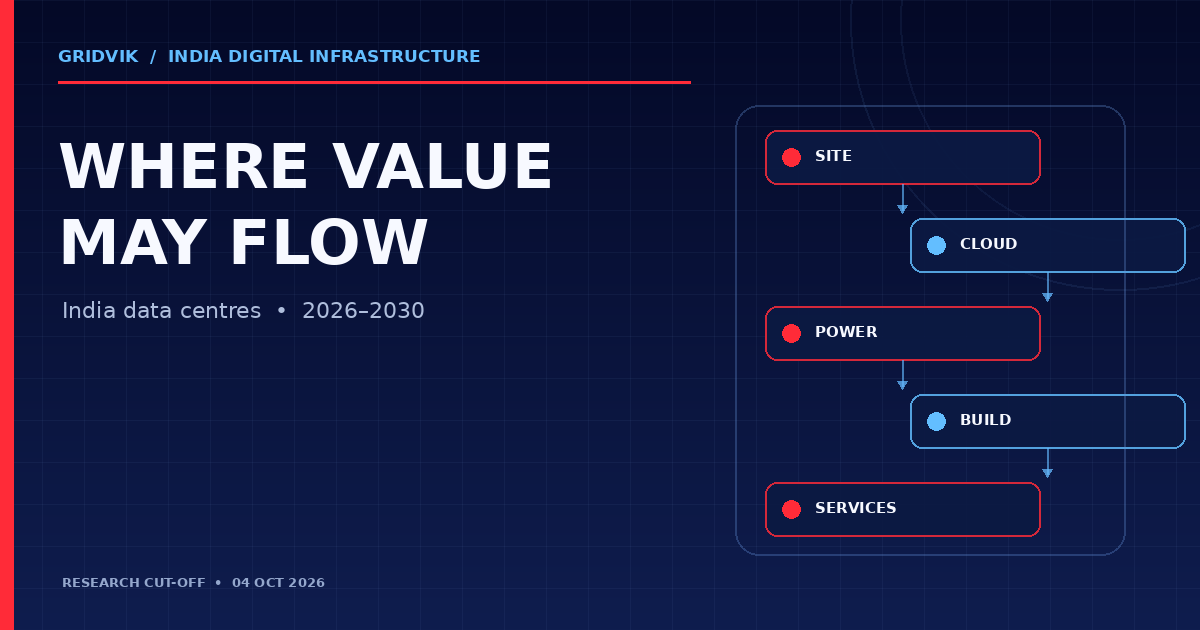
- Five value pools across the data-centre economy
- How a project turns demand into revenue
- An illustrative example: a hypothetical 20 MW expansion
- Why location changes the opportunity
- The risks that can erase an attractive headline
- A practical decision framework for companies
- What to measure before calling an opportunity profitable
- How Gridvik fits into the research process
- Frequently asked questions
- Sources and further reading
The short answer: where value can accrue
A data centre is not one business. It is a chain of interdependent businesses. A customer needs reliable compute close to users or data; an operator supplies a secure facility and the services around it; the facility needs land, grid access, backup systems, cooling, fibre, construction, finance and operations. Each layer can generate a different kind of revenue, on a different schedule and with a different risk profile.
The simplest way to understand the opportunity is to ask four questions:
- Who pays? A cloud customer, colocation tenant, hyperscaler, data-centre developer, utility, government agency or another supplier?
- What is being sold? Compute, rack space, power, a building, a construction package, equipment, connectivity, operations or advice?
- When does payment begin? At design, equipment order, commissioning, lease commencement, consumption, or an ongoing service renewal?
- What has to happen first? A project announcement may still need land, permits, grid capacity, finance, a signed customer, construction and commissioning before it generates operating revenue.
The demand story is real enough to attract large commitments, but the scale of the opportunity should not be confused with the profit available to every participant. A hyperscaler’s multi-year India commitment may include cloud infrastructure, AI services, staff, training and other activities. A state’s capacity target is a policy ambition, not a built facility. A proposed campus capacity is not the same as live, contracted IT load. Those distinctions matter because each affects the time and probability of receiving cash.
For a supplier, the most accessible opportunity may not be to own a campus. It may be to solve a bottleneck for a developer or operator: provide a reliable transformer, commission a cooling system, deliver network diversity, reduce water use, or maintain a facility. For an investor, the question is whether contracted revenue and asset quality justify the price and financing. For a founder, it may be whether a repeatable service can be sold across several projects rather than relying on one headline customer.
A useful conclusion is therefore conditional: India’s data-centre expansion can create profitable opportunities, but profit is earned by solving a specific customer problem at a viable price and with execution risk under control. The rest of this article shows where to look and what to test.
What “profit” means in a capital-heavy industry
The word “profit” is used loosely in market commentary. It can mean revenue, gross margin, operating cash flow, EBITDA, accounting profit, a return on invested capital, or a gain on the sale of an asset. These are not interchangeable. A business can report growing revenue while consuming cash; a new facility can have high contracted demand but weak returns because construction costs or debt service are excessive; an equipment supplier can make a sale yet face low margins, warranty liabilities or delayed customer payments.
Revenue is only the first line of the model
A colocation operator can invoice for reserved capacity, power consumption and additional services. A construction contractor can invoice for milestones. A cooling-equipment supplier may book a purchase order and later earn from parts and maintenance. A cloud platform can bill customers for compute, storage, networking and managed services. These revenue streams are not directly comparable: they differ in duration, usage risk, payment terms and capital requirements.
When reading a claim about a “profitable data-centre market,” identify the level being discussed. Is the claim about the cloud-services market, the real-estate asset, the operator, the equipment supplier, or the entire digital economy? A report that estimates the value of cloud services does not automatically show the margin of the building owner. A company’s national investment commitment does not reveal the return on a particular campus. A state’s projected GDP effect is not a project-level profit calculation.
Margin, utilisation and capital intensity
A facility has costs before it can serve a customer: site acquisition or lease, design, construction, electrical and mechanical systems, generators, substations, cooling, network routes, security, commissioning and finance. After opening, the operator continues to pay for maintenance, labour, power, taxes, insurance and equipment refresh. These costs exist even if a portion of the building is empty.
Utilisation is therefore central. If a 20 MW facility has only 8 MW contracted and billable, it does not earn the same as a fully utilised 20 MW site. The operator may still have to keep the whole campus safe, cooled, connected and ready. Similarly, a vendor with a large addressable market may win only a small share of procurement, and its gross margin may be offset by bid costs, local installation, warranty exposure, inventory financing and long collection periods.
Returns depend on time as well as price
A project that reaches its target utilisation in year two can have a very different return from one that reaches it in year five. Delays can increase interest during construction, push out revenue, invalidate equipment assumptions and create penalties under customer contracts. The relevant question is not only “How big is the announced project?” but also “What portion is financed, built, commissioned, contracted and billable—and when?”
For this reason, this article uses “value pool” to mean a layer where customers may spend money. It does not mean a guaranteed margin, a recommended investment, or proof that every participant will earn attractive returns. Investors should model cash flows and conduct due diligence with qualified advisers; companies should validate the customer, scope, technical specifications and payment terms before hiring or buying inventory.
Why capital is moving into Indian digital infrastructure
Several long-running trends support demand for digital infrastructure: more online services, enterprise migration to cloud, digital payments, streaming, data-intensive applications, AI training and inference, and the need for resilient, locally reachable cloud regions. A data centre is one physical part of that wider system. It is where computing equipment is installed, connected to networks and supplied with electricity and cooling. The customer value may be a cloud service, but the physical delivery depends on the facility and its supporting infrastructure.
Capacity is expanding, but forecasts differ
Savills’ public H1 2026 market summary reports 1.8 GW of operational IT capacity in India and says that around 258 MW IT was added in the first half of 2026. The same public summary states a 2030 outlook of 6 GW IT. Cushman & Wakefield’s H1 2026 update also reports operational capacity of nearly 1.8 GW and a pipeline of nearly 3.9 GW across under-construction and planned projects. That pipeline must not be added to operational stock as though every project were already serving customers.
Forecasts are not uniform. Wood Mackenzie’s July 2026 release forecasts operational data-centre capacity rising from 2.2 GW in 2025 to 12 GW by 2030. Its baseline differs from the Savills public H1 summary, so the two numbers should not be averaged or represented as a single settled outcome. Definitions, project coverage, capacity scope and forecast assumptions can differ. The defensible message is that capacity is expected to grow; the exact 2030 level is uncertain and should be attributed to the source each time it is used.
Announcements show the scale of interest—not cash already spent
Public announcements illustrate why the market is attracting attention. Google said its Visakhapatnam AI hub would involve approximately US$15 billion over five years from 2026 to 2030, combining gigawatt-scale data-centre operations with energy and fibre infrastructure. Google subsequently announced a groundbreaking in April 2026. The company describes the programme as an AI hub and a multi-part infrastructure investment; the full US$15 billion should not be presented as a construction contract for one building.
Microsoft announced US$17.5 billion over 2026–2029 for India’s cloud and AI infrastructure, skills and ongoing operations, on top of an earlier US$3 billion commitment. AWS has described a US$12.7 billion India cloud-infrastructure plan by 2030; its announced US$8.3 billion Maharashtra plan is part of that earlier all-India plan, not an extra amount to add on top. Amazon’s wider India investment announcements cover more than data centres: its US$35 billion 2025 commitment was across its businesses, and its 2026 announcement described an additional US$13 billion focused on AI and cloud infrastructure. These are different categories and time frames; they are not a clean tally of data-centre construction spending.
Digital Connexion, a joint venture of Brookfield, Reliance Industries and Digital Realty, announced a plan to invest US$11 billion in a 1 GW campus in Visakhapatnam by 2030 under a memorandum of understanding with Andhra Pradesh. Meta and Reliance announced an agreement for Meta to lease capacity at a 168 MW AI-enabled facility in Jamnagar, with options to scale; the companies did not publish a facility investment amount in that announcement. Both examples are significant, but a plan or an agreement is not the same as a completed, operating campus.
Power and water influence what can actually be delivered
A data centre needs dependable electricity continuously, not just a headline allocation or an annual renewable-energy certificate. A site can look attractive because land is available, but the project still needs a credible route to firm power, substations and transmission capacity. Developers may combine grid supply, renewable procurement, storage and backup systems. Each choice has commercial, technical and regulatory implications.
Cooling design is connected to both power and water. Traditional air-cooled systems, chilled-water designs and direct-to-chip liquid cooling have different requirements, and their suitability depends on rack density, climate, facility design, operating practice and water strategy. A location decision should examine water availability and discharge requirements, not just the cooling equipment brochure. Wood Mackenzie’s July 2026 analysis highlights power strategy as a competitive differentiator and identifies water availability as a material site risk. Savills also notes that suitable land and power facilitation remain important challenges in the Indian market.
The opportunity is therefore not simply “more servers.” It is the coordinated delivery of secure buildings, power, cooling, water, fibre, equipment and people. Companies that reduce a project bottleneck can become valuable suppliers—but only if the buyer has budget, the technical solution is approved, and the project proceeds.
How to read the market numbers without mixing them
A reader can make a very different decision depending on whether a number describes operational capacity, a design target or an investment commitment. Before using any headline, record at least five fields: metric, unit, geography, status, and source date. The table below offers a simple reading guide.
| Figure or claim | What it can mean | What it does not prove |
|---|---|---|
| Operational IT capacity | IT load in commissioned facilities, under a named source’s methodology | That every MW is occupied, profitable or available for a new customer |
| Under-construction capacity | A project or phase reported to be in construction | That the full campus will be delivered on schedule or fully leased |
| Planned or proposed capacity | A design aspiration, announced development, MoU, or future phase | That land, grid access, financing, approvals and customers are secured |
| Investment commitment | A company’s stated multi-year spending plan or a report’s aggregated estimate | Cash already spent, pure data-centre capex, or a single project’s funding |
| Absorption or take-up | Capacity leased, contracted or otherwise taken up under a report’s definition | Total installed capacity or operator profitability |
| State capacity target | A policy objective or government ambition | Installed, under-construction or privately financed capacity |
| Project investment amount | A stated project budget, estimate or company plan | Equity invested to date, debt drawn, audited capex or return earned |
Why two published forecasts can disagree
Consultancies can start from different inventory lists, count different kinds of facility, treat phases differently, use different dates, or include planned projects at different levels of confidence. A “data centre stock” series may refer to live IT load in named cities; another model may include facilities beyond those cities or use an expected commissioning schedule. A forecast can also differ because it uses different assumptions about cloud growth, AI server density, project execution or power availability.
A responsible article does not hide those differences by selecting the largest number as fact. It attributes every projection, identifies whether it is operational or planned, and says when the methodologies may differ. If an audience needs a single working scenario for a budget, that scenario should be explicitly called an assumption—for example, “base case used for this model”—rather than the market’s guaranteed outcome.
Why commitment totals should not be added mechanically
Large corporations may announce overlapping plans. A parent company’s commitment may include an infrastructure subsidiary. A national investment plan may contain a state-specific plan. A cloud infrastructure commitment may overlap with a wider AI commitment. A research firm’s cumulative market total may already include public announcements from hyperscalers and operators. Adding the totals together can double-count the same capital or mix a broad economy commitment with a project-specific budget.
A clean ledger should store the entity making the statement, date, geography, period, activity covered, relationship to other announced plans, whether the amount is a commitment or deployment, and the source URL. It should also keep the source’s wording. If the company says “AI and cloud infrastructure, skilling and operations,” do not rewrite that as “data-centre construction capex.”
A practical evidence label
A useful public tracker can label each item as one of the following: operational, under construction, announced, MoU / proposal, financing announced, or policy target. These are not a universal legal standard; they are editorial labels to help readers avoid mistaking intent for delivery. A second field can describe the evidence quality: official company or government statement, filing, named report, credible media report, or single-source estimate. A third field records the date last checked.
That discipline is useful to vendors as well as investors. A supplier deciding whether to add inventory should care whether a project is still an MoU or has begun construction. An investor comparing markets should distinguish a live asset from a site option. A sales team should not treat a procurement window as certain unless an owner, consultant, public tender or project document supports it.
Five value pools across the data-centre economy
There are many ways to divide the value chain. This guide uses five groups because they connect the most common business questions: who owns and operates capacity, who provides digital services, who builds the physical site, who supplies power and cooling, and who earns through connectivity or specialist services. A company may work in more than one pool. The labels are analytical, not formal industry classifications.
1. Site development, ownership and colocation operations
A developer assembles land, utilities, permissions, finance, design and delivery partners. An owner may retain the asset; an operator may lease it, manage it, or provide colocation services. Some companies perform several roles, while joint ventures distribute responsibilities among partners. A build-to-suit arrangement can give a customer more influence over design and capacity, but it does not remove construction, power or financing risk.
Colocation operators typically sell space and infrastructure to customers that want servers hosted in a professionally managed facility. The commercial product can include an agreed power capacity, rack or suite space, cross-connects, remote hands, security and other operational services. The revenue profile may include recurring charges over a contract term, but cash flow depends on whether capacity is committed, when a customer can take it, how much power is used, and who bears the cost of power and pass-through items.
The operator’s economic opportunity is recurring revenue and efficient use of a long-lived asset. Its challenge is the large upfront investment and the time between spending and billing. A new campus may be developed in phases so that capital is released as customer demand becomes clearer. Phasing can help reduce unused capacity, but it requires coordination: shell-and-core work, power availability, fit-out, network, commissioning and customer readiness must align.
The questions for this pool are specific. Does the operator have a signed lease or only a customer discussion? Is the contract tied to a minimum capacity, or can the customer defer? Is power a fixed cost, a pass-through, or a mixture? Who pays for upgrades? What happens if construction slips? What is the customer concentration after the first phase? How much remaining capex is needed to deliver the contracted capacity? Without these answers, a big campus number says little about profit.
For an investor, the owner/operator distinction matters. The asset owner may receive rent from an operator; the operator may earn a service spread; a cloud provider may earn from compute usage. One physical building can therefore support several entities with different economics. Do not assume that the company named in an announcement owns the entire asset, books every dollar of revenue, or carries every risk.
2. Cloud, AI and managed digital services
Hyperscalers and cloud providers translate physical capacity into digital services. Customers pay for virtual machines, storage, databases, AI services, networking, software tools and managed platforms. Their economics are not simply the same as those of a property landlord: they combine infrastructure, software, global networks, customer support, product development and large-scale procurement.
A local cloud region can help customers address latency, resilience, data-location and regulatory needs. Multiple availability zones can be designed to improve resilience, but customers still need to architect their applications for failure. A cloud region is a logical and physical service footprint; the marketing announcement of a region does not itself disclose the exact number of MW, facilities, tenant occupancy or return on the investment.
The commercial opportunity for smaller firms is often indirect. Systems integrators, managed-service providers, security firms, migration specialists, AI software vendors and data-governance advisers can help enterprises make better use of cloud infrastructure. They may earn implementation fees, recurring managed-service revenue, software subscriptions or support fees. They need credible expertise and a route to the buyer; merely having a cloud provider in the city does not guarantee local contracts.
AI changes the workload mix and can increase the demand for high-density power and cooling. But “AI demand” is not a purchase order. A data-centre developer must still know who will occupy the capacity, what compute is required, when the equipment arrives, how the power is secured and whether the commercial model supports the capital. A company selling AI infrastructure services should test customer willingness to pay, the cost of accelerators and energy, utilisation assumptions, depreciation, software licensing and the pace of hardware refresh.
Cloud and AI services can scale across customers, which may support attractive economics for a successful platform. They can also require substantial investment in hardware, software, data, security and talent. The right comparison is not “cloud equals low capex” or “AI equals high margin.” It is a specific service’s recurring revenue, gross margin, churn, compute cost, sales cycle and customer lifetime value.
3. Construction, engineering, equipment and commissioning
A data-centre project creates demand for specialist design, civil works, electrical systems, mechanical systems, controls, security, fire protection, generators, UPS, switchgear, transformers, cabling and commissioning. These opportunities arise at different points. A designer may be engaged before ground is broken; an EPC contractor may be paid against milestones; a component supplier may receive an order after the design is locked; a commissioning specialist may be needed near handover; maintenance revenue can continue after opening.
This pool can be more accessible than campus ownership because a small or mid-sized firm may supply a package or service rather than finance the entire asset. The competition is still demanding. Data-centre buyers require uptime, quality assurance, documentation, redundancy, safety, cybersecurity and compliance. A low initial price can be offset by failure risk, liquidated damages, warranty costs or a slow customer approval process.
A vendor should begin with the specification, not the headline project. Which voltage, capacity, redundancy and certification requirements apply? Is the equipment on the approved-vendor list? Is the project using air cooling, chilled water or liquid cooling? Is the customer buying directly or through an EPC / consultant? Is the scope local or imported? Who handles installation, commissioning and warranty? Are there local service engineers and spare parts? When is the purchase order expected, and what evidence supports that date?
The sales opportunity also changes by project stage. A project announcement may create an early conversation with an owner or consultant, but not necessarily an open tender. Design and engineering can influence specifications; a later tender may be limited to pre-qualified vendors. However, the timing differs by package and project. It is risky to turn a rough construction timeline into an exact procurement date without evidence. The “two quarters before go-live” rule sometimes used in the market can be a planning prompt, not a universal fact.
For contractors, the most important profit variables may be utilisation of crews, procurement lead times, variation orders, site conditions, project sequencing, contract payment terms and retention. For original equipment manufacturers, gross margin can be affected by imported inputs, currency movements, channel incentives, local assembly, competition and after-sales obligations. For commissioning or maintenance providers, repeat business depends on response times, qualified staff, safety records and customer trust.
4. Power, renewables, storage and water solutions
Power is a commercial product and a delivery constraint. A data centre requires electrical supply that matches the facility design, with redundancy and quality suitable for mission-critical workloads. It may depend on utility supply, transmission upgrades, substations, open-access procurement, captive generation, renewable power purchase agreements, battery storage and backup generation. The chosen mix affects both reliability and cost.
The opportunity can accrue to utilities, independent power producers, renewable developers, transmission and distribution contractors, battery-storage providers, energy-management software firms, backup-power specialists and consultants. Some parties earn from a long-term power contract; others earn from equipment, construction, development or operation. The business case should distinguish nameplate generation from delivered power at the data-centre node. A solar plant’s MWp figure is not the same as firm 24/7 MW supply. Storage duration, grid access, transmission losses, curtailment, open-access charges, backup fuel and contractual shape all matter.
Power procurement is not simply a sustainability line item. The buyer needs to understand whether a renewable project is synchronized with the facility’s demand, whether the contract is operational, whether the grid can deliver it, and what happens when generation is unavailable. If the project claims “renewable-powered,” ask whether that describes a signed power purchase agreement, an expected mix, an annual energy match, or a future ambition. Those statements have different implications.
Cooling and water form a related value pool. Equipment providers may supply chillers, cooling towers, CRAH / CRAC systems, pumps, controls or liquid-cooling components. Water treatment firms can provide monitoring, recycling, wastewater treatment or desalination-related services. Energy-efficiency firms can help measure performance and identify operational improvements. But water needs are site- and design-specific; no single cooling technology is right for every facility. A solution’s economics depend on climate, rack density, redundancy, local water rules, power tariff, plant design and operating skill.
The environmental and community context matters. A facility may be technically feasible yet face local concerns about water, land use, traffic, noise, emissions or grid competition. A developer that engages early, publishes credible environmental information, and designs for resource stewardship may reduce execution risk. A supplier can differentiate through measurable reductions in energy or water use, but it should support performance claims with a transparent baseline and measurement method.
5. Connectivity, security, advisory and recurring services
Data centres connect customers to networks, cloud providers, internet exchanges, subsea cable systems and other facilities. Fibre carriers, dark-fibre providers, cable landing stations, interconnection platforms, network-equipment vendors and managed-security firms can earn from connectivity and services. A facility’s value is not just its building; it must reach the networks and customers that make it useful.
Connectivity revenue can include ports, cross-connects, wavelengths, managed network services and private connections. The economics depend on route diversity, capacity, latency, carrier availability, customer demand and competitive pricing. A site with a single route may look connected on a map but carry a different resilience profile from a site with physically diverse routes. A “new cable landing” announcement is a long-term infrastructure signal; it does not automatically mean every campus has immediate, diverse fibre paths.
Security, compliance and operational services can also produce recurring revenue. Examples include 24/7 facility operations, equipment monitoring, incident response, cyber security, compliance readiness, environmental monitoring, asset management, training and energy optimisation. These services can help reduce downtime or resource use, which gives them a tangible customer value proposition. They require domain expertise and must be integrated with the operator’s security and change-control processes.
Advisory and professional services may earn through feasibility studies, site-selection support, engineering design, power studies, project management, financing advice, procurement support, legal work, environmental assessments or market research. They are often less capital intensive than owning a facility, but they can be cyclical and relationship-driven. A firm should define a repeatable scope, evidence its expertise, control conflicts of interest and avoid claiming privileged access when its work relies on public information.
This pool is also where a focused research product can create value. A data-centre supplier may need to know which projects are announced, what stage they have reached, who the buyer is, what public source supports the claim and how old the evidence is. A research service can reduce discovery time; it cannot guarantee an introduction, a tender or a sale. The value is better information and prioritisation, not an assured outcome.
How a project turns demand into revenue
A data-centre project moves through a chain of decisions, and each decision changes the commercial prospects for a different participant. The timeline is not linear for every project, but a simplified lifecycle helps locate the revenue opportunity.
| Stage | Typical evidence to look for | Potential spend or revenue | Key uncertainty |
|---|---|---|---|
| Market study / site search | Company statement, public land process, local policy, consultant activity | Feasibility, power studies, legal and advisory work | Will the company select the site? |
| Announcement / MoU | Company or government release, signed MoU, capacity ambition | Design, land, policy facilitation, preliminary services | Is the commitment binding, financed and permitted? |
| Site control / approvals | Land lease or purchase, planning, environmental and utility processes | Development, design, grid work, long-lead equipment planning | Are permits and power deliverable? |
| Construction | Groundbreaking, contractor appointment, visible works, financing | Civil works, electrical and mechanical packages, equipment | Schedule, cost, scope and customer changes |
| Fit-out / commissioning | Equipment installation, testing, customer acceptance | Final equipment, integration, commissioning and training | Does the facility pass tests on time? |
| Live / ramp-up | Operational notice, available capacity, customer service launch | Colocation leases, cloud consumption, operations, maintenance | Utilisation and consumption ramp |
| Expansion / refresh | New phase, signed customer, additional power or building | Repeat construction, hardware, cooling and support work | Does incremental demand justify capex? |
Signals that are useful—and signals that are weak
A public announcement is useful for understanding intent and direction. It can identify a geography, partner or target capacity. A signed customer agreement, land acquisition, environmental approval, power agreement, contractor appointment, financing close or construction start generally provides a different level of evidence. A vendor should note which public signal it has and what the signal does not establish.
A press release saying “up to 1 GW” may describe ultimate development potential rather than an immediate phase. A groundbreaking event marks a construction milestone, not live service. A state approval for a park may enable units without proving which customers will lease them. A company’s cloud region going live can show service availability while leaving facility-level MW undisclosed. Labels in a tracker should reflect those nuances.
Sales teams can map their own work to stages. A design or site-selection firm may benefit from engaging when a project is still being defined. A long-lead transformer vendor may need to understand the utility and project schedule early. A commissioning provider may need to qualify months before handover. A maintenance provider may sell after operations begin. Each category should build its own evidence base from public tenders, job postings, filings, planning documents, announcements and conversations with customers. The exact buying window should be confirmed with the project team rather than inferred from a generic timeline.
A helpful commercial question is “What must be true before this revenue is recognized?” For construction, it may be a signed scope and verified progress. For equipment, it may be a purchase order plus delivery and acceptance. For colocation, it may be customer handover and a billing start. For cloud, it may be actual usage. A forecast based on an announcement alone can be several steps removed from revenue.
An illustrative example: a hypothetical 20 MW expansion
The following example is deliberately hypothetical. It is designed to show how to test a business model, not to estimate a live Indian project, a price, a margin or an investment return. It uses round numbers and leaves contract rates blank because rates depend on customer, specification, location, tariff, redundancy, tax, design and other terms.
Imagine an operator is planning a 20 MW IT-load expansion in phases. It has a site, a preliminary utility plan and discussions with potential customers. A vendor sells electrical and cooling packages; an infrastructure fund is considering a financing round; a cloud customer may lease capacity after commissioning. Before calling this a profitable project, each party builds a separate model.
Operator’s model
The operator should split planned capacity into phases and record the amount that is: (a) design capacity, (b) funded and under construction, (c) commissioned, (d) contractually reserved and (e) actually billable. If a first phase is 5 MW, the next 5 MW may depend on customer take-up and power upgrades. The site may still incur shared costs before all phases are occupied.
A simple revenue structure might be:
- Monthly recurring charge for reserved capacity or a defined facility service.
- Variable charge linked to actual electricity use, if the contract passes through power.
- Optional charges for interconnection, remote hands, cross-connects, monitoring or other services.
- One-time setup or installation charges, where agreed.
The revenue model should be paired with a cost model: site and construction capex, equipment, interest during construction, power, water, staffing, maintenance, insurance, taxes, software and replacement reserves. The model should test whether the customer pays for reserved capacity even if it does not immediately use all of it, who bears the power-price risk, and what the contract says about ramp, termination and service levels.
Supplier’s model
The equipment supplier should not assume it wins all 20 MW. It should model a realistic scope share: perhaps one building, one system, or a defined package. The model should subtract engineering, bidding, compliance, freight, import duties if relevant, installation, commissioning, warranty reserve, local service and collection costs. A vendor can compare a direct sale with a channel partnership, but must include the channel margin and responsibility for service.
Timing is also a cash-flow issue. A purchase order might require inventory months before delivery. The supplier may receive an advance, milestone payments, a retention amount or payment after acceptance. If payment terms are 90 days and supplier bills are due earlier, working capital can become a limiting factor even if gross margin looks attractive. A small vendor should identify its maximum exposure per project and avoid letting one delayed site threaten the entire company.
Investor’s model
The investor should model total committed capital, draw schedule, debt terms, construction contingency, customer contract, power strategy, stabilisation timeline, occupancy, and exit assumptions. It should stress-test lower occupancy, delayed commissioning, higher interest, lower cloud demand, customer concentration, exchange-rate changes and cost overruns. A project may have substantial strategic value while still offering a weaker return than expected if risk-adjusted cash flows do not support the valuation.
Sensitivity without invented prices
A useful first sensitivity is billable capacity. If the 20 MW design has only 5 MW contractually reserved, that is a different position from 15 MW reserved. The company can model each case in units of MW or kW and insert its own validated tariff. A second sensitivity is delay: what happens if first billing starts six months later? A third is power: what is the effect if the cost or availability differs from plan? A fourth is capex: what if long-lead equipment or grid upgrades are more expensive?
| Scenario variable | Lower case | Base case | Higher case | Why it matters |
|---|---|---|---|---|
| Billable capacity | Lower contracted MW | Expected contracted MW | Faster customer ramp | Revenue and asset utilisation |
| Commissioning date | Delayed phase | Planned date | Earlier acceptance | Interest, cash flow and customer timing |
| Power economics | Higher cost / constraint | Contracted plan | More favourable procurement | Ongoing cost and service availability |
| Construction capex | Overrun | Budget | Savings | Debt, equity and return on capital |
| Customer concentration | One large customer | Diversified base | Multiple tenants | Renewal, credit and vacancy risk |
The main insight is not a particular result. It is the discipline of creating a separate model for each participant, using evidence for customer demand and power, and leaving assumptions visible. A project is not “profitable” because a table lists MW and dollars. It is profitable only if realised revenue, after all costs and capital, produces a return that compensates for risk.
Why location changes the opportunity
The Indian market is often described as a small number of established hubs plus a set of emerging locations. That is a useful starting point, not a ranking of winners. Each city or state needs to be tested for power, land, water, fibre, customer demand, workforce, policy, construction capability and local acceptance. A business that serves one corridor may have a strong position even if a different city has more installed capacity.
Mumbai and the wider Mumbai region
Mumbai has a mature data-centre ecosystem and strong connections to financial institutions, enterprises, cloud providers and subsea cable routes. CBRE’s 2025 market update said around 90% of existing Indian capacity was concentrated across Mumbai, Chennai, Delhi-NCR and Bengaluru, using its methodology and date. A mature hub can mean customer density, experienced contractors, carriers and operational talent. It can also mean competition for land, power, construction resources and qualified staff. The relevant question is not merely whether Mumbai is the largest market; it is whether a specific site can deliver dependable power and serve the target customer at a viable cost.
Chennai and Tamil Nadu
Chennai has a substantial data-centre and network ecosystem, including international connectivity and operators with established facilities. Savills’ H1 2026 summary identifies strong absorption across major cities, with Chennai an important market. A vendor should look at the actual facilities, phases, owners and procurement documents rather than treat statewide announcements as a single order book. The corridor may suit services tied to network, cloud, enterprise and hyperscale requirements, but individual projects still depend on land, grid and water arrangements.
Hyderabad and Telangana
Hyderabad is a technology and cloud centre with operational AWS infrastructure and Microsoft’s India South Central cloud region, which Microsoft announced as a major part of its India cloud and AI investment. A cloud region can stimulate an ecosystem of customers, partners and suppliers; it does not disclose all facility capacity or assure third-party vendor access. For a company considering expansion, map which services are in production, which are in construction, and what the specific customer will buy. Do not use one cloud-region milestone as proof that every nearby data-centre project is live.
Visakhapatnam and Andhra Pradesh
Visakhapatnam illustrates the difference between a large investment narrative and operational capacity. Google’s official announcement describes a US$15 billion AI hub over five years, with gigawatt-scale data-centre operations, energy and fibre components, and its April 2026 post reports that the project broke ground. Digital Connexion separately announced an US$11 billion, 1 GW campus plan by 2030 through an MoU with the state. These are distinct initiatives, and neither should be counted as 1 GW of live capacity merely because a target has been announced. For suppliers, the corridor may create future opportunities in power, construction, cooling, network and services, but project phasing, customer specifications, power delivery and procurement remain central.
Gujarat, including Jamnagar and Dholera
Gujarat’s Viksit Gujarat Data Centre Policy 2026–29 sets a state capacity target of 7.5 GW and public investment ambition. It also includes eligibility conditions and incentive provisions; for example, the policy applies to qualifying large projects, and NASSCOM’s analysis notes a 150 MW minimum for certain incentives and a 51% green-energy requirement. Those are policy rules and targets, not completed capacity or automatic grants to every project. Meta and Reliance announced a lease agreement for a 168 MW AI-enabled facility in Jamnagar; the capacity and project details should be described as announced, not live unless a later operating source confirms that status.
Uttar Pradesh, including Noida and Greater Noida
Uttar Pradesh released a Data Centre Policy 2026 with an official target to mobilise more than ₹2 lakh crore in investment and develop a future-ready ecosystem. The policy describes subsidy and support provisions, but eligibility, caps, definitions and approval requirements matter. A state investment target should not be substituted for a signed private project budget. Noida and Greater Noida may have advantages for serving North Indian customers and enterprise demand; actual project viability still depends on land title, grid capacity, approvals, water and construction execution.
An emerging-market comparison table
| Corridor | Publicly visible strengths | Questions that decide the project | Potential supplier angle |
|---|---|---|---|
| Mumbai region | Established demand, network ecosystem, operators and financial customers | Land, power node, cost, redundancy and competition | Operations, upgrades, interconnection, power, cooling |
| Chennai | Network links, enterprise and operator presence | Site power, phase timing, water and tenant commitment | Network, cooling, fit-out, facility services |
| Hyderabad | Cloud and technology ecosystem | Which capacity is live, which is being built, and who buys? | Cloud partners, electrical and mechanical packages |
| Visakhapatnam | Major AI-hub announcements and new connectivity ambition | MoU vs financed phase, grid, water, fibre routes and schedule | Early design, power, transmission, land and network |
| Gujarat | Dedicated policy, renewables and large project ambitions | Eligibility, policy implementation, firm power and water | Power systems, renewable integration, cooling, local services |
| Noida / Greater Noida | North Indian enterprise reach and state policy support | Site-specific utility capacity, approvals and phase status | EPC, grid interface, operations and enterprise supply |
The matrix should not be read as a final location recommendation. A company should compare its buyer and service scope against the corridor’s actual project evidence. For example, a regional commissioning business may prefer where it can recruit and respond quickly; a power developer may value transmission and open-access conditions; a cloud partner may focus on customer density and technical accreditation. A location with a large target but no timely grid capacity may be less useful than a smaller, operational hub.
The risks that can erase an attractive headline
Growth and profit are not synonyms. A market can expand rapidly while some projects are delayed, some vendors face weak margins, or some operators spend ahead of demand. A strong business case identifies these risks before committing capital or building a sales plan.
1. Power is not secured just because a site is announced
A site may be selected before its final electricity arrangement is ready. The team needs to know the approved load, connection point, construction timeline for transmission assets, redundancy, tariff, quality, backup design and conditions for open access. A renewable-energy commitment may be useful but must be mapped to delivered energy, location, timing and contractual terms. Without that, a vendor’s opportunity may move out by quarters or years.
2. Announced capacity can be confused with demand
A campus can have a high design capacity but no public tenant information. A company may be developing capacity to meet future demand, but the ramp may be slower than expected. A supplier should ask whether the order is tied to a funded phase, a pre-lease, an approved budget or an uncommitted possibility. An investor should separate a customer commitment from a marketing pipeline.
3. Utilisation may take longer than planned
Even after commissioning, the asset may not be fully occupied. Customer migration, networking, hardware procurement, approvals and workload deployment take time. The operator may carry fixed costs while occupancy is low. Demand can also shift among on-premises, cloud, colocation and edge environments. A project model should stress-test the lease-up period and not assume every announced MW becomes recurring revenue immediately.
4. Construction and equipment create schedule risk
Large electrical and mechanical equipment can have long lead times. Civil works, approvals, grid upgrades, specialised labour, import logistics, commissioning and design changes may cause delay. A contractor should understand the dependencies in its scope and the payment milestones. A buyer should confirm whether equipment is available, whether substitutes are approved and who bears the cost if delivery slips.
5. Capital costs and interest can rise
A project may rely on a mix of equity, debt, internal funding or customer commitments. If debt costs increase or a project takes longer to commission, interest during construction can rise. Foreign currency equipment may also expose the buyer to FX movement. A supplier paid in rupees but buying in dollars should model currency risk and hedge where appropriate. A large capex budget may be funded in stages; the announcement itself does not mean every rupee is committed or available today.
6. Water, environment and community risk matter
Cooling and water strategies can affect permitting, operating cost and local acceptance. A site in a water-stressed area needs a credible source, treatment, recycling and discharge plan. Desalinated water may be part of a solution near a coast, but it requires infrastructure and operational safeguards. Community impact, local livelihoods, land acquisition, traffic, noise and emissions can shape project acceptance. A sustainable claim should be tied to a disclosed metric and scope, not an adjective.
7. Customer concentration and contract terms can change returns
A project may rely on one hyperscaler, a single tenant or a small number of customers. The strength of that counterparty can lower some risks, but the project is exposed to renewal, expansion and credit decisions. For vendors, one large customer can dominate receivables and delivery capacity. Companies should review contract duration, termination rights, service-level penalties, price escalation, power pass-through and change-order protections.
8. Competition can compress margins
New entrants may compete on price, incentives or financing. Established operators may have a cost advantage from scale, while new developers may offer custom designs. Equipment buyers may negotiate several qualified bids. A vendor can win revenue and still lose money if it underestimates commissioning, warranty or local-service costs. A consultant can face price pressure if it sells generic reports rather than differentiated, evidence-backed analysis.
9. Forecast error is a business risk
Forecasts help companies plan, but no forecast is a guarantee. If demand is slower, customers may delay take-up. If AI workload density accelerates, power and cooling needs may grow but the project may need different equipment than originally specified. Policy can change, implementation may differ from announcement, and macroeconomic or regulatory conditions can shift. A resilient plan tracks leading indicators and makes staged commitments.
10. “One-size-fits-all procurement timing” can mislead
The sequence of design, tender, equipment order and commissioning varies by developer, owner, package and project phase. A two-quarter lead-in before go-live can serve as a prompt to start asking questions, but not as a universal purchasing calendar. The vendor must validate with public tenders, project documents, owner updates, consultants and approved-vendor processes. The safer product claim is “estimated procurement window, with date and confidence,” not “exact buy date guaranteed.”
A risk register should have an owner, trigger, impact, response and evidence link. For example: “utility connection delayed” is more actionable if the company identifies the connection milestone, source of evidence, expected effect on commissioning and escalation path. The aim is not to eliminate uncertainty; it is to avoid disguising uncertainty as a firm sales forecast or investment fact.
A practical decision framework for companies
The right entry route depends on the company’s capabilities, balance sheet, product, customers and tolerance for long timelines. A small specialist firm and a large infrastructure fund should not use the same decision process.
If you are an equipment supplier
Start with a narrow scope and a named buyer. List the equipment classes you can supply, required certifications, service coverage, design partners and reference installations. Identify which project stages create a legitimate conversation for that package. Then verify the evidence: project operator, public status, estimated phase, possible customer, source date and procurement route. Create a target list that shows uncertainty rather than hiding it.
Before entering a new state, assess local service and installation capacity. A strong product may still be difficult to deploy if there is no trained commissioning team, spare-part stock or approved distributor. Check whether the customer procures directly or through an EPC, consultant or global framework. Build pricing for installation, commissioning, warranty, taxes, logistics and payment delays. Do not buy inventory solely because a campus has been announced.
If you are a contractor, engineering firm or consultant
Clarify the qualification route, past-performance requirements, safety and quality systems, subcontractor network, bonds and insurance. Project owners may prefer vendors with documented critical-facility experience. Build a realistic resource plan: can your teams complete the work without stretching other contracts? Identify scope exclusions, commissioning responsibilities, design changes and acceptance conditions. A signed contract with a clear scope is more informative than a news story.
If you are an infrastructure investor
Separate the project thesis from the broader India thesis. Model one asset’s land, power, connectivity, capex, finance, lease-up, operating cost, customer contracts and exit scenarios. Ask whether a project is operating or under construction, whether the MW is IT load, and which entity owns the asset. Validate the data with company filings, lenders, government records and independent technical diligence. Stress-test a delayed grid connection, a delayed customer, a lower utilisation path and refinancing risk.
If you are a power or renewable-energy developer
Understand the buyer’s required load shape, reliability, location, delivery point, contract term and credit profile. Study open-access rules, transmission, curtailment, banking, charges and state-specific policy. Confirm whether a proposed captive arrangement is legally and technically viable. Model how storage or firming affects the levelized cost and whether it can deliver the reliability requirement. A large DC target in a state does not itself guarantee a PPA.
If you are a technology startup or service provider
Select one painful, measurable problem rather than “AI for data centres” in general. Possible use cases include predictive maintenance, energy management, cooling optimisation, security monitoring, asset documentation, water tracking, ticketing or compliance workflows. Find the operations owner and the integration constraints. Prove value in a small pilot with baseline, controls and success criteria. Make sure the product can be deployed securely within the customer’s network and complies with their change-management process.
A simple fit matrix
| Company type | Lower-capital starting point | Evidence needed before investing more | Common failure mode |
|---|---|---|---|
| Equipment SME | Qualified subcontract or local service | Buyer, approved specification, schedule, payment terms | Stocking inventory for an unconfirmed project |
| EPC / contractor | Bid for a bounded package | Tender or signed scope, site readiness, labour plan | Underpricing scope and site risk |
| Digital service vendor | Paid pilot for an operations use case | Measured baseline, sponsor, security approval | Selling a generic demo without an operator owner |
| Power developer | Feasibility and buyer qualification | Load profile, node, route-to-market, permits | Treating a capacity target as an energy contract |
| Fund / investor | Due-diligence pipeline and model | Land, power, customer, finance, execution team | Underwriting on uncommitted pipeline |
| Advisory / research firm | Clear productised scope | Public evidence, repeatable methodology, buyer need | Promising insider data or precise tender dates |
What to measure before calling an opportunity profitable
A company should translate a headline into a dashboard of operating indicators. The exact data will differ by business, but a practical baseline includes the items below.
Demand and contract indicators
- Contracted MW, reserved MW, operational MW and billable MW, reported separately.
- Number of customers and percentage of revenue or capacity tied to the largest customer.
- Contract duration, renewal options, termination rights and minimum commitments.
- Customer credit, deposit, parent guarantee or other security, if disclosed.
- For vendors: scope size, purchase order status, customer approval and payment milestones.
Delivery and capex indicators
- Land control and planning / building approvals.
- Utility connection capacity, delivery date, substations and transmission dependencies.
- Financing committed, drawn and still required; do not treat a press release as a drawdown.
- Capex budget versus actual, contingency, long-lead equipment and commissioning schedule.
- Phase-by-phase completion dates and acceptance milestones.
Operating indicators
- Utilisation and occupancy, measured consistently.
- Power availability, energy cost and any pass-through mechanism.
- Cooling performance and facility efficiency metrics, including scope and period.
- Water source, consumption, recycling and discharge information where material.
- Service levels, outage history, maintenance backlog and trained staff coverage.
Financial indicators
- Revenue by product and customer type.
- Gross margin after direct installation, service, freight and warranty costs.
- Operating cash flow and working-capital days.
- Debt cost, interest cover, capex commitments and maturity schedule.
- Return on invested capital under base, downside and delay cases.
An operator, supplier and cloud business will use these metrics differently. The principle is to connect the business outcome to the actual unit sold. A vendor may measure quote-to-order conversion and cash collection. An operator may focus on contracted and billable capacity, power availability, capex and customer concentration. A cloud service may track paid usage, compute cost, retention and customer expansion. A project-finance investor may focus on coverage ratios, contract quality and delivery risk.
A five-question investment screen
Before approving a large commitment, ask:
- What is the evidence? Is it a press release, MoU, regulatory filing, approved permit, signed order or operating record?
- What is the exact status? Announced, planned, financed, under construction, commissioned, contracted or live?
- Who pays, and for what? Is the revenue source contractually identified, and what unit is billed?
- What is the binding constraint? Power, land, water, fibre, equipment, talent, customer demand, financing or approvals?
- What changes the decision? Which milestone, metric or risk would make the company pause, proceed or re-price?
A “yes” to all five does not make the project risk-free. It makes the decision more disciplined. It also helps a company avoid a common trap: treating the strongest upside scenario as the base case and leaving no budget for delay or rework.
How Gridvik fits into the research process
Gridvik is positioned as an independent India data-centre research and market-intelligence business. Its public pages describe a project tracker, state-policy comparison, power layer and estimated procurement windows, with public-source references, dates and confidence labels. That can help a user organise market research and decide which questions to validate next. It is not private access to a project, a tender guarantee, an introduction to a budget owner or investment advice.
A sensible workflow is to start with the public tracker and sample, read how Gridvik describes its research method, and then decide whether a state deep-dive or weekly GridFeed fits the work. The dataset is most useful when readers click through to the original source and verify status, date and capacity before making a decision.
For an equipment seller, the tracker could be one input to territory planning: filter a corridor, list target projects, mark evidence quality, note a project’s status and contact the relevant buyer through a legitimate channel. For an investor, it can be a starting inventory for diligence, not a substitute for engineering, legal, commercial and financial reviews. For a founder, it can help reveal which state-policy questions or power constraints deserve primary research.
Research products are most credible when they state what they do not know. A public announcement may not disclose a customer, exact capacity by phase, financing drawdown, construction contractor or procurement date. A useful tracker should leave those fields as unknown instead of filling them with a guess. It should also show conflicting reports rather than averaging them away. Readers should check the source link and the last-verified date before relying on an entry.
If you want a broader view of how companies can participate in the market, a source-led map of investment announcements and funding types, or an explanation of power and site-readiness risks, continue with the companion guides. The aim is not to promise that a reader will win a contract; it is to make the questions and evidence clearer. For a broader market overview, see the India data-centre expansion guide.
Frequently asked questions
Is India’s data-centre boom guaranteed to make companies profitable?
No. Growth can create customer demand and supplier opportunities, but outcomes depend on pricing, utilisation, power, financing, construction, contracts, costs and execution. A market forecast is not a profit forecast for an individual company.
How large is India’s data-centre market in 2026?
There is no single figure that applies to every definition. Savills reports 1.8 GW of operational IT capacity in H1 2026; Cushman & Wakefield also reports nearly 1.8 GW and a nearly 3.9 GW combined pipeline of under-construction and planned projects. Each figure should be attributed and kept separate from future capacity.
Will India have 6 GW, 7 GW or 12 GW by 2030?
Public forecasts differ. Savills’ H1 2026 summary says 6 GW IT by 2030, while Wood Mackenzie’s July 2026 release forecasts 12 GW. Other published coverage cites figures above 7 GW. These projections use different assumptions and may use different scopes. Treat them as scenarios, not installed capacity or a guarantee.
Which companies make money from data centres?
Potential participants include facility owners and operators, cloud providers, construction firms, electrical and mechanical suppliers, renewable-energy developers, network carriers, security providers, consultants, maintenance companies and specialist software firms. Whether any specific company is profitable depends on its contracts, cost base, capital and execution.
Can a small company enter the data-centre supply chain?
Possibly. A smaller firm may provide a specialist service, local maintenance, commissioning, software, network support or a defined equipment package. It should qualify the buyer and scope, understand certification and service requirements, and control working-capital exposure. There is no guarantee that a public project announcement will produce an order for a small supplier.
Is a 1 GW announced project already a 1 GW operating data centre?
No. A gigawatt figure can refer to a long-term design ambition, a planned campus or an announced programme. It should not be described as live unless a reliable source confirms the capacity is commissioned and operational. Project phases should be tracked individually where possible.
Does Google’s US$15 billion India announcement mean US$15 billion of data-centre construction?
Google described the commitment as a five-year investment in its Visakhapatnam AI hub, with data-centre operations, energy and fibre infrastructure. It is broader than one building’s construction budget. The announcement should be presented using Google’s scope and wording.
Is Amazon’s US$35 billion or US$48 billion all data-centre investment?
No. Amazon’s US$35 billion 2025 announcement was across its businesses in India. A June 2026 announcement described an additional US$13 billion focused on AI and cloud infrastructure and a US$48 billion 2026–2030 total. The broader figures include more than one business or activity and should not be labelled as a pure data-centre capex figure.
How can a vendor estimate when to contact a project?
Use a project-specific evidence trail: owner announcements, tenders, planning records, contractor or consultant updates, permit milestones and public commissioning targets. A rough lead-time heuristic can prompt early research, but it is not a confirmed buying date. Verify the procurement route and specification with the relevant project team.
What is the difference between an investment commitment and money spent?
A commitment is a company’s stated plan or an analyst’s aggregate of announced plans. Deployment is capital actually spent or drawn. A commitment may be phased, conditional, broader than data-centre construction or overlapping with another announced amount. Keep the source, date, period and scope with every figure.
Is this article investment advice?
No. It is general market education based on public sources. It does not recommend buying or selling a company, asset or security, and it does not replace legal, financial, engineering or tax advice.
Sources and further reading
- Savills — Data Centre Market Watch, H1 2026
- Cushman & Wakefield — India Data Centre Market, H1 2026
- Wood Mackenzie — India data-centre capacity forecast, 27 July 2026
- CBRE — India’s Data Centre Market in a New Era, 2025 YTD update
- Google — India AI hub investment announcement
- Google — Visakhapatnam groundbreaking, 28 April 2026
- Microsoft — US$17.5 billion India commitment
- AWS / About Amazon — Maharashtra plan and the earlier India cloud-infrastructure plan
- Amazon — US$48 billion India investment announcement, June 2026
- Digital Connexion — 1 GW Visakhapatnam MoU, reported by Data Center Dynamics
- Meta — Reliance AI-enabled data-centre lease announcement
- Gridvik Resources, methodology and services
Gridvik is an independent research firm. This article is informational, uses public-source material and is not investment advice. Forecasts and project plans can change; verify facts with the original source before relying on them.