
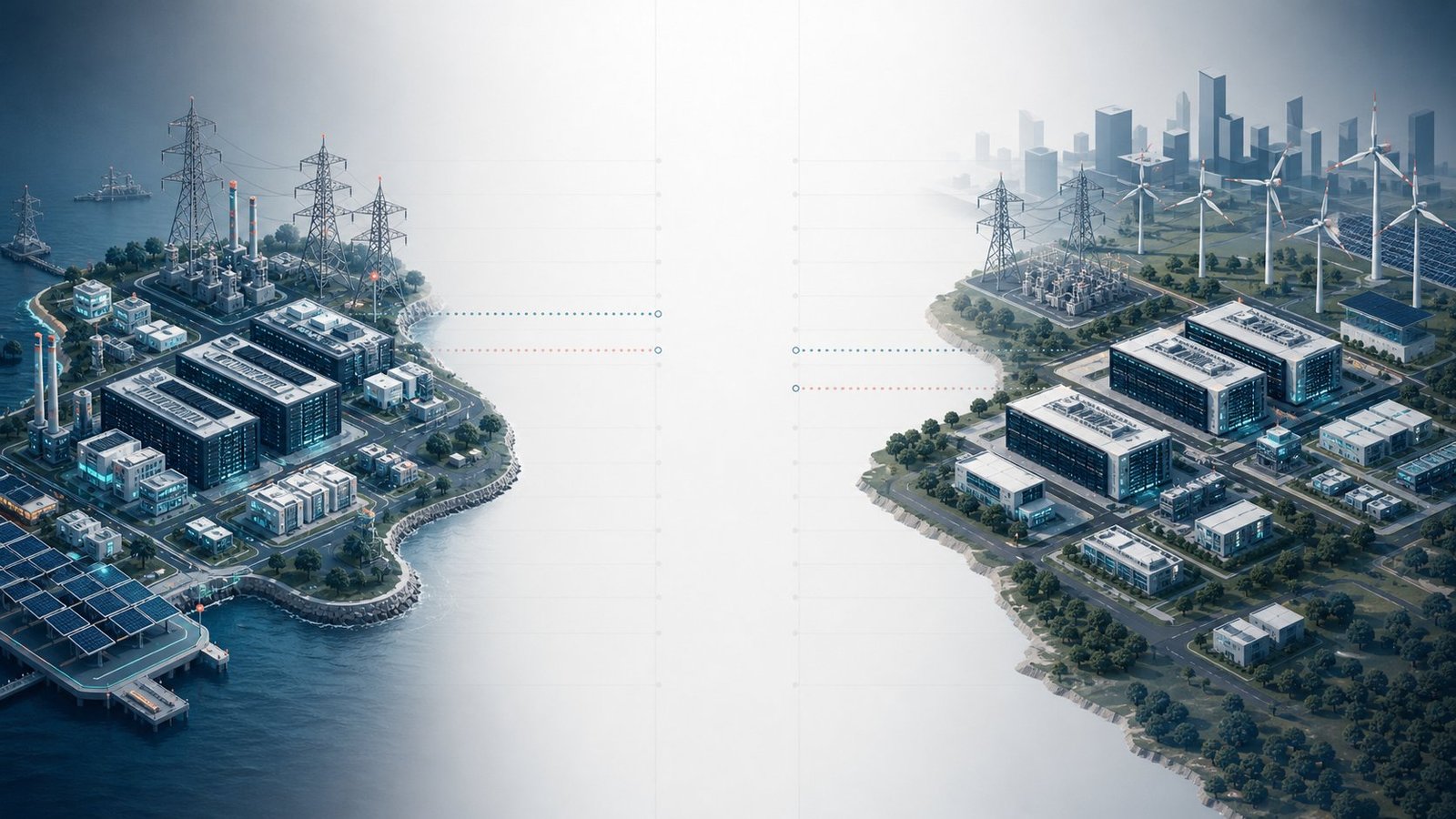
The short answer: Singapore’s capacity announcements and India’s investment signals are real, but the public evidence reviewed here does not establish that capital was diverted from Singapore to India.
Evidence checked through 1 November 2026 (IST). This is a source-led test of what the “capital shift” label can support—not a claim that Singapore is losing data-centre investment, or that India captured money from a cancelled Singapore project.
Three different Singapore figures sit behind the debate: a 200 MW provisional allocation under the second Data Centre Call for Application (DC-CFA2); a planned Jurong Island park with potential for up to 700 MW of power capacity; and an earlier policy roadmap that described additional capacity pathways. India’s broad Singapore-source foreign-investment figures and a reported Chhattisgarh proposal are separate evidence again. These are not interchangeable measures, and they should not be added into a single capacity total or described as a financial transfer.
The key nuance is that the four DC-CFA2-supported facilities are to be located on Jurong Island, while JTC describes the planned park as an expected key site for this new wave. That establishes a relationship at the island and programme level. The public material reviewed does not publish a complete award-to-plot map or say exactly how much of the 200 MW is counted inside the park’s 700 MW potential. Treat the scopes as potentially connected—not as a proven one-for-one overlap.
First, separate capacity from capital
Megawatts describe a power or facility-capacity measure. They do not state how much money has been committed, raised, paid in, drawn down or spent. A site that could accommodate a given power capacity is not the same thing as a built facility of that size; a provisional allocation is not an operating data centre; and neither is a ledger of financing.
“Capital shift” is a stronger claim than “India is attracting investment” or “Singapore has announced new capacity.” To show a shift, evidence would need to connect the same investor, a Singapore-side decision not to deploy a defined pool of capital, and a traceable deployment of that capital into a specified Indian project. A Singapore-headquartered company, a Singapore-source FDI line, or a project announced at a Singapore forum does not, on its own, establish that chain.
There are also measurement questions. The EDB fact sheet describes the 200 MW as new “DC capacity”; JTC describes the park’s potential as “power capacity.” The public descriptions do not provide a common technical basis or conversion showing these numbers are directly comparable. Do not silently relabel either figure as IT load, commissioned utility load or construction spend.
What Singapore’s 200 MW DC-CFA2 allocation actually says
On 21 August 2026, the Singapore Economic Development Board (EDB) and Infocomm Media Development Authority (IMDA) said they had provisionally allocated 200 MW of new data-centre capacity to four selected proposals under DC-CFA2. The official fact sheet names Digital Realty, Equinix, Keppel Data Centres and ST Telemedia Global Data Centres, with 50 MW provisionally allocated to each. More than 20 proposals were received. The fact sheet describes a selection through an open competitive process; its operative wording for the capacity is still “provisionally allocated.” EDB’s results announcement and its selection fact sheet set out the terms.
This is a capacity-allocation milestone, not evidence that 200 MW is already live. The announcement does not disclose a combined construction budget for the four facilities, the amount of equity paid, a debt/equity funding schedule, financial close, or the amount of capital already deployed. Nor does it identify a pool of money withdrawn from a Singapore project and transferred to India.
The selected proposals also carry material sustainability and efficiency requirements. EDB and IMDA say the supported data centres will power more than 50% of their data-centre capacity from green-energy sources, use liquid cooling and 100% energy-efficient IT equipment, and meet the Green Mark for Data Centres Platinum standard. The original call required at least 50% of the proposed capacity to use eligible green-energy pathways, Green Mark for Data Centres Platinum certification, and a PUE of 1.25 or better at 100% IT load. These conditions help explain the policy design; they are not financing figures.
The agencies say the supported facilities will be located on Jurong Island. That is the strongest official location statement relevant to the overlap question. It does not, by itself, place every awarded facility within the boundary or accounting envelope of the separate 20-hectare park described by JTC.
What Jurong’s “up to 700 MW” plan means—and what it does not
JTC’s 27 October 2025 announcement says about 20 hectares on Jurong Island have been set aside for the development of Singapore’s largest data-centre park, with potential to accommodate up to 700 MW of power capacity. “Set aside,” “development” and “potential” describe a planning envelope. They are not a statement that a 700 MW park is built, occupied, powered or financed.
JTC’s 14 April 2026 story says the park is expected to be a key site for the new DC-CFA2 capacity wave. The same story discusses Jurong’s energy ecosystem and its role in testing low-carbon pathways. JTC’s 24 November 2025 announcement describes a separate 2026 study of a microgrid testbed and thermal networks. A study or testbed programme is not proof that the whole planned park has been delivered.
So, what can be said with confidence? The island is the stated location for DC-CFA2-supported facilities; the park is a planned 20-hectare development with up-to-700 MW power-capacity potential; and JTC expects it to be a key site for the next capacity wave. What remains unpublished in the sources reviewed is a plot-by-plot schedule, the allocation of each operator to the park, the capacity counted against the 700 MW envelope, a common MW basis, and a complete construction/commissioning timetable.
That distinction matters because “Jurong Island,” “the planned Jurong data-centre park,” and “DC-CFA2-supported facilities” are related but not automatically identical scopes. The island is a geographic location; the park is a planned development; the allocation is a programme decision. A relationship between them is not a licence to assume every MW sits inside the same boundary or phase.
Why the 200 MW, 700 MW and earlier roadmap figures cannot be stacked
Singapore’s May 2024 Green Data Centre Roadmap announcement described at least 300 MW of near-term additional capacity and another 200 MW associated with green-energy pathways. The second call for applications, launched on 1 December 2025, said at least 200 MW would be made available, with potentially more through innovative green-energy pathways. The 2026 result then provisionally allocated 200 MW. JTC’s 700 MW is a separate site-planning potential figure.
These announcements belong to a policy and development sequence, not to four independent buckets that can safely be summed. Public material reviewed does not provide a one-to-one reconciliation of the 2024 roadmap, the 2025 DC-CFA2 call, the 2026 provisional selection and the Jurong park envelope. Some figures could refer to the same planned capacity at different stages or describe different scopes. The sources do not quantify the overlap.
| Figure | What the source calls it | Status / scope | What not to infer |
|---|---|---|---|
| 200 MW | DC-CFA2 capacity provisionally allocated to four proposals | Four operators at 50 MW each; supported facilities to locate on Jurong Island | Not 200 MW of live capacity, disclosed capex, or proof of an exact 200 MW inside the 700 MW park envelope |
| Up to 700 MW | Potential power capacity for a planned Jurong Island data-centre park | About 20 hectares set aside for development; a planning potential, not a commissioned site total | Not 700 MW operating, not a confirmed IT-load figure, and not automatically additional to DC-CFA2 |
| At least 300 MW + another 200 MW | 2024 Green Data Centre Roadmap expansion pathways | Earlier policy-level near-term and green-energy figures | Not a separate current project total that can be stacked with the later call and park |
| At least 200 MW available | DC-CFA2 call launched in December 2025 | Application-stage capacity invitation; the 2026 result provisionally allocated 200 MW | Not a second 200 MW to add to the 2026 allocation |
For the same reason, subtracting the 200 MW allocation from 700 MW to announce “500 MW still available” is not supported either. That calculation presumes a common measurement basis, a complete mapping of the awards into the park, and no other scope changes. The public sources do not establish those premises. The disciplined phrasing is: 200 MW provisionally allocated; up to 700 MW power-capacity potential for the planned park; relationship exists at the island/programme level, exact crosswalk not published.
What the India-bound evidence shows—and what it cannot show
A Singapore-source FDI figure is not a data-centre capital ledger
DPIIT’s country-wise FDI equity-inflow fact sheet records US$19.802 billion attributed to Singapore for FY2025–26. For April–June 2026, a report citing DPIIT data puts Singapore at US$5.22 billion of India’s Q1 FY2026–27 FDI equity inflows. The quarterly figure is a different period from the annual total; do not add them or annualise the quarter from this comparison. The official DPIIT fact sheet and Mint’s 25 September report of Q1 data are the relevant references.
These are broad, all-sector country-attribution figures—not data-centre-only flows. They do not identify which Indian project received the money, whether the investment was in a data-centre operator or another sector, what the ultimate beneficial source of the funds was, or whether the investment corresponded to a reduction in Singapore data-centre spend. A country attribution in a national FDI table is not a project-level transaction trail.
The data supports a narrower statement: Singapore is a significant source-country attribution in India’s reported FDI series. It does not establish that Singapore-origin capital funded a specified Indian data centre, much less that it was withdrawn from a Singapore facility. Corporate headquarters, treasury location, immediate investing jurisdiction and ultimate capital origin can differ; without project-level documents, keep those categories separate.
The SING Forum figure needs a precise split
Coverage of Chhattisgarh’s 5 October 2026 SING Forum announcement reported ₹43,250 crore as the total proposal figure. Within that reported total, ₹41,750 crore was associated with a proposed 100 MW AI-ready data-centre campus from Singapore-headquartered Energy Capital Global; the remaining ₹1,500 crore was reported separately for a solar, battery-storage and components proposal from Sunstream Green Energy. ANI’s report calls the amounts proposals and says the Chief Minister handed Energy Capital Global an “Investment Invitation Letter.” Outlook’s same-date coverage describes the event and the separate green-energy proposal. The distinction is material: ₹43,250 crore is not the data-centre figure.
Public reports use “proposal,” “commitment” and “pledge” with varying strength. For an evidence ledger, the conservative label is reported investment proposal/commitment at a forum, not verified financial close, FDI equity inflow, construction capex paid or cash disbursed. The reports reviewed do not provide a financing close, drawdown schedule, project-level audited spend or a documented link to capital removed from a Singapore data-centre project. The fact that the announcement was made in Singapore, or that the company is headquartered there, does not prove the source or movement of the money.
It is a meaningful signal of investment interest and a stated project ambition. It is not evidence that the announced 100 MW is operational, that the full headline amount has been funded, or that a Singapore project lost the same capital. The direct state-government release referred to in the coverage was not independently located in this review, so the amounts are attributed to the reporting and should be rechecked against any subsequent official project filing.
Dated evidence ledger: what each source actually supports
| Evidence item | Source-dated status | Supports | Does not establish |
|---|---|---|---|
| DC-CFA2: 200 MW | EDB/IMDA, 21 Aug 2026; provisional allocation, four × 50 MW | A selected, sustainability-linked Singapore capacity pipeline; all supported facilities on Jurong Island | Live capacity, capex deployed, exact plot allocation, or transfer to India |
| Jurong park: up to 700 MW | JTC, 27 Oct 2025; about 20 ha set aside for planned development | A site-planning potential measured as power capacity | Commissioned capacity, committed capital, or an exact DC-CFA2 overlap |
| Earlier roadmap | EDB, May 2024; 300 MW near-term plus another green-energy pathway figure | Policy direction and capacity ambition | A separate, additive current project pipeline |
| Singapore-attributed FDI into India | DPIIT FY2025–26: US$19.802 bn; Q1 FY2026–27: US$5.22 bn reported | Broad country-attributed FDI equity flows across sectors | Data-centre-specific funding or a Singapore-to-India project transfer |
| SING Forum / Chhattisgarh | 5 Oct 2026 coverage: ₹43,250 cr total reported proposals, including ₹41,750 cr for a proposed 100 MW data centre and a separate ₹1,500 cr green-energy proposal | Reported intent and market interest | Verified financial close, paid capex, operational MW, or funding diverted from Singapore |
Labels in this ledger are deliberately stage-specific: roadmap, site potential, provisional allocation, FDI equity inflow and reported proposal are not synonyms. A careful reader can track momentum without turning intent into completion or a company’s jurisdiction into a capital-origin claim.
What evidence would make “capital shifted” a defensible finding?
A strong claim would need a named, dated chain that can be checked from both ends. At minimum, it would identify:
- The investor and the Singapore-side decision: which sponsor, lender or fund reduced, cancelled or deferred a specified Singapore project, and what public filing or attributable statement establishes that change.
- The Indian destination: the named project, sponsoring entity, financing vehicle, amount and timing of equity or debt actually closed or disbursed—not only a capacity announcement or invitation letter.
- The funding link: a filing, financing document, transaction announcement or attributable company disclosure showing that the money released from the Singapore plan funded the Indian project. A common corporate parent is not enough without tracing the funds.
- A comparable counterfactual: evidence that the funds would otherwise have been invested in the Singapore project, rather than new capital supporting simultaneous expansion in both markets.
- Consistent measurement and timing: aligned project boundaries, MW definitions, dates and financing stages, with any overlap between parent portfolios, campus phases, tenants and hosts made explicit.
Without those links, other explanations remain plausible: a multinational may add capacity in both countries; an Indian project may have a different investor or financing pool; Singapore may appear in an FDI table as a financial conduit; or an announcement may not progress to close. These are alternative possibilities, not claims about the named operators. The point is that capacity growth on one side and investment interest on the other do not identify which explanation is true.
Useful follow-up evidence would include operator filings, disclosed project financing, land or power agreements tied to a specific development, construction and commissioning records, and audited project-level expenditure. Each source should be dated and labelled as company-reported, regulator-reported, independently corroborated or still unverified. A bank loan announcement is financing availability, not automatically a cash draw; a signed MoU is not financial close; and a grid connection is not proof of the original source of equity.
Verdict: parallel capacity plans and Indian investment interest—not a proven capital diversion
Singapore’s 200 MW DC-CFA2 allocation is provisional; Jurong’s up-to-700 MW figure is a planned park’s power-capacity potential; India’s Singapore-source FDI data is broad and all-sector; and the Chhattisgarh data-centre amount is a reported proposal, not verified disbursement. The figures describe real policy and market signals, but they are not a financial-flow bridge.
The most accurate headline conclusion is therefore bounded: India is attracting investment interest, while Singapore continues to plan data-centre capacity; the evidence reviewed does not show that capital was diverted from Singapore to India. The 200 MW and 700 MW should not be summed to 900 MW or netted to a supposed 500 MW remaining without an official crosswalk. The ₹43,250 crore SING Forum headline should not be labelled as the data-centre proposal alone; that reported data-centre component is ₹41,750 crore, and neither is proof of financial close.
Frequently asked questions
Are the 200 MW DC-CFA2 allocation and the 700 MW Jurong park the same project?
No. The 200 MW is provisionally allocated across four selected proposals. The up-to-700 MW figure is the planned park’s power-capacity potential. EDB says the supported facilities will be on Jurong Island, and JTC expects the park to be a key site for the DC-CFA2 wave, but the public sources reviewed do not provide a complete award-to-plot or capacity crosswalk.
Can I add 200 MW to 700 MW and call it 900 MW of new Singapore capacity?
Not on the evidence reviewed. The figures may be connected or overlap, use different scopes and are at different planning stages. The 200 MW is a provisional allocation; the 700 MW is a site potential. An official reconciliation is needed before adding them.
Is the 200 MW already operational?
The EDB/IMDA announcement describes it as provisionally allocated to four proposals. It does not say the 200 MW is commissioned or live, and the announcement does not publish total capital deployed.
Does Singapore’s US$19.802 billion FY2025–26 FDI figure mean Singapore invested that amount in Indian data centres?
No. It is a country-attributed FDI equity-inflow figure across sectors. It is not a data-centre-only amount, and it does not identify ultimate capital origin or prove a link to any particular Singapore project.
What is the correct SING Forum figure for the proposed data centre?
The reported total proposal figure was ₹43,250 crore. The reported 100 MW data-centre proposal was ₹41,750 crore; a separate ₹1,500 crore green-energy proposal was also reported. These are proposal/commitment announcements, not independently verified financial close or cash disbursement.
Does a Singapore-headquartered company prove that its investment is Singapore capital?
No. Headquarters, immediate investing jurisdiction, treasury location and ultimate source of funds can differ. A project-level financing trail is required to establish capital origin and movement.
What would prove that capital shifted from Singapore to India?
Evidence linking a defined Singapore project or investment pool that was reduced or cancelled to financing actually closed or disbursed for a named Indian project, with the same investor and a defensible counterfactual. Broad FDI totals, MW announcements, MoUs and common corporate ownership are not enough by themselves.
Is Jurong’s 700 MW a construction or operating target?
The JTC source describes potential power capacity for a planned park. It is not presented as 700 MW already built, occupied or commissioned. Treat it as a planning potential until later source-dated development and operating evidence changes that status.
Method, scope and correction note
This page was refreshed on 1 November 2026 using public material available by that date. Official Singapore agency and JTC statements are used for capacity, location and programme status. DPIIT is the primary source for the annual FDI equity-inflow fact sheet; the Q1 country figure is attributed to DPIIT as reported by Mint. The Chhattisgarh breakdown is attributed to same-day ANI and Outlook coverage; the public state release cited in that coverage was not independently located during this review.
We preserve the distinction between capacity, site potential, proposals, country-attributed FDI and cash deployed. We do not infer a funding trail from company domicile, conference location, policy language or overlapping geographies. No company or public official was contacted for this refresh, no outreach was made, and no independent financial close or disbursement was verified. Later filings could change the evidence status; any update should be dated and source-linked.
Sources and documents reviewed
- EDB, “Four data centre proposals selected as part of second data centre”, 21 August 2026; official announcement of provisional 200 MW allocation.
- EDB/IMDA fact sheet, “Four data centre proposals selected…”, 21 August 2026; four operators, 50 MW each, sustainability conditions and Jurong Island location.
- EDB, “Launch of Second Data Centre – Call for Application”, 1 December 2025, and the launch fact sheet; application-stage capacity and minimum efficiency/green-energy requirements.
- JTC, “Jurong Island celebrates 25 years with new focus on powering the future of low-carbon innovation”, 27 October 2025; approximately 20 hectares and up to 700 MW power-capacity potential.
- JTC, “Jurong Island celebrates 25 years with new industry partnerships…”, 24 November 2025; 2026 testbed and thermal-network study context.
- JTC, “Why Singapore is building data centres on Jurong Island”, 14 April 2026; describes the planned park as an expected key site for the new DC-CFA2 capacity wave. The article was originally published by w.media and republished with permission.
- EDB, “Singapore to expand data centre capacity by at least one-third, pushes for green energy”, May 2024; earlier roadmap figures.
- DPIIT, FDI fact sheet through FY2025–26; country-wise FDI equity inflow series.
- Mint, Q1 FY2026–27 FDI report, 25 September 2026; reports Singapore at US$5.22 billion in DPIIT country-wise data.
- ANI, “Chhattisgarh receives Rs 43,250 crore FDI proposals at inaugural SING Forum in Singapore”, 5 October 2026; reports the total proposals and the ₹41,750 crore 100 MW data-centre proposal, and says an Investment Invitation Letter was presented.
- Outlook, “Singapore’s Energy Capital Global to Invest ₹41,750 Crore…”, 5 October 2026; reports the separate ₹1,500 crore green-energy proposal and attributes the announcement to a state release.
Continue your Gridvik data-centre research
For related questions about how project stages and capacity totals should be reconciled, continue with:
- The 500 MW Double-Count Claim: What a 172 MW Parent–Phase Audit Can—and Cannot—Prove — tests how parent programmes and phases can be compared without assuming a duplicate.
- Karnataka’s Sustainable Data Centre Policy, 2026–2031 — separates policy intent from dated project evidence.