
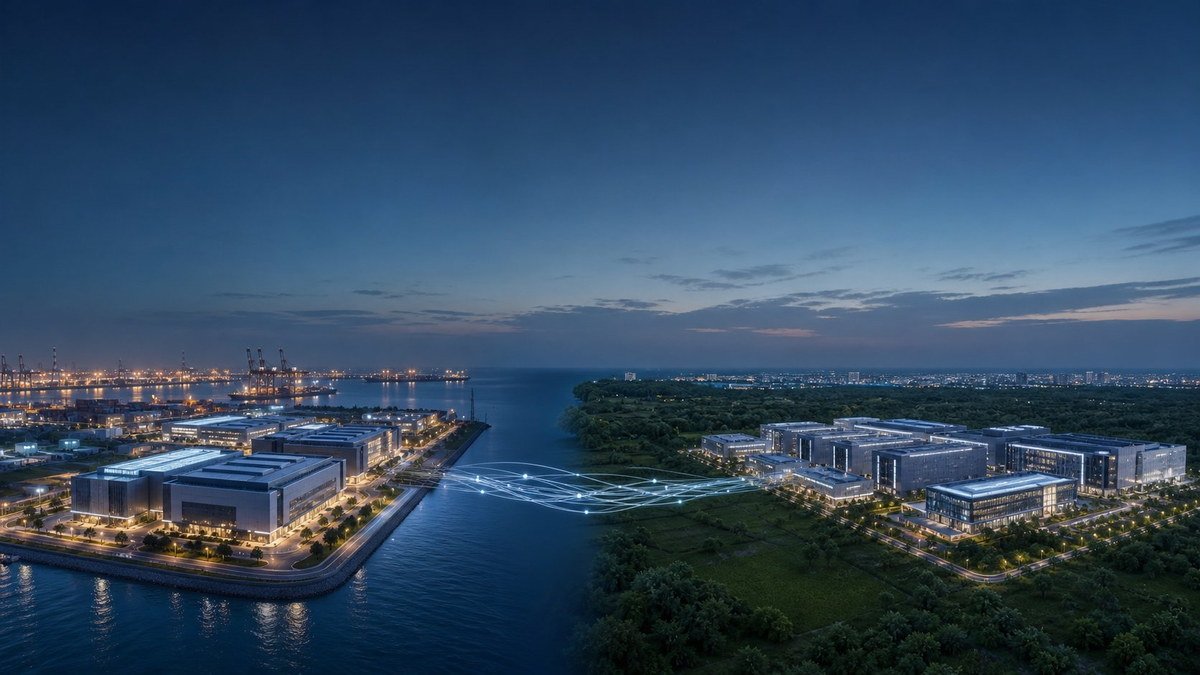
The Singapore capacity figures are real; they don’t, by themselves, prove capital moved from Singapore to India.
Public-source check through 12 October 2026 (IST). This is a test of what the “capital shift” label can support—not a claim that Singapore is losing data-centre investment or that India has captured money from a cancelled Singapore project.
Short answer: The sources show Singapore provisionally allocated 200MW to four data-centre operators, while JTC has set aside about 20 hectares on Jurong Island for a planned park with potential to accommodate up to 700MW of power capacity. Those are capacity milestones, not capital-flow figures. India is receiving investment interest, and India’s official FDI series records substantial equity inflows attributed to Singapore—but neither fact traces the same money from a Singapore data-centre project into an Indian one. On the public evidence reviewed, capital diversion is not established.

First, separate five claims that often get collapsed into “capital shift”
“Capital shift to India” can mean several different things. They need different evidence:
- India is attracting more investment than before. Test with dated, comparable investment-flow data, while checking the sectors and definitions.
- A Singapore-domiciled or Singapore-headquartered company is investing in India. That identifies a corporate connection—not necessarily the ultimate source of its financing.
- A company has announced or proposed an Indian project. That is evidence of intent or a stated commitment, not automatically a financial close, construction spend or deployed capital.
- Investors are funding both markets. That can be parallel expansion; it is not inherently a transfer from one country to another.
- A specific pool of money moved from Singapore to India instead of being invested in Singapore. This is the strongest meaning. It requires a traceable investor decision and financial/project evidence linking the two sides.
The 200MW and 700MW figures help describe Singapore’s capacity pipeline. They do not tell us how much project finance was raised, how much equity was paid in, whether capital was released from another site, or what an investor would otherwise have built in Singapore.
What Singapore’s 200MW allocation actually says
On 21 August 2026, Singapore’s Economic Development Board (EDB) and Infocomm Media Development Authority (IMDA) said they had provisionally allocated 200MW of new data-centre capacity under the second Data Centre Call for Application, or DC-CFA2. Four proposals were selected, with 50MW provisionally allocated to each of Digital Realty, Equinix, Keppel Data Centres and ST Telemedia Global Data Centres. The agencies said they had received more than 20 proposals.
The word provisionally matters. This is a selection and capacity-allocation milestone—not 200MW of operating data halls. The fact sheet says the selected operators made sustainability commitments, including powering more than 50% of their proposed data-centre capacity from green-energy sources. It does not report a total construction budget, funding mix, amount of equity paid, or capital already deployed for the four facilities.
The agencies also say the supported facilities will locate on Jurong Island. A JTC story republished on 14 April 2026 goes further: it describes the planned 700MW park as a key site for the new wave of DC-CFA2 capacity. That points to a programmatic connection, not merely a shared island. But neither source assigns the four provisional 50MW awards to plots inside the 20-hectare park or says the full 200MW counts against its 700MW potential. The allocation announcement also does not specify a capacity basis that can safely be compared one-for-one with JTC’s “power capacity” description.
The earlier 1 December 2025 call launch said at least 200MW would be made available, with potentially more capacity through new and innovative green-energy pathways. The August 2026 result therefore tells us that 200MW was provisionally allocated under that call; it does not turn the allocation into commissioned supply or disclose a capital-expenditure total.
What Jurong’s “up to 700MW” means—and what it does not
In an October 2025 announcement, JTC said about 20 hectares on Jurong Island had been set aside for Singapore’s largest data-centre park, with the potential to accommodate up to 700MW of power capacity. JTC described the park as a development initiative that can use the island’s shared infrastructure and emerging low-carbon energy sources. A November JTC update reiterated that the park was being developed and described it as a potential site for AI-ready, low-carbon technology trials.
That is a site-and-capacity envelope. It is not evidence that 700MW has been allocated to named operators, built, energised, leased or commissioned. Nor is it a 700MW investment commitment: megawatts measure capacity, while capital expenditure is a money value. A project’s cost depends on scope, phasing, equipment, power works, cooling, land and financing; a MW figure cannot be converted into a reliable dollar amount without project-level disclosures.
The 200MW and 700MW figures should therefore not be added to produce a 900MW Singapore total. JTC’s “key site” wording supports an expected planning overlap between DC-CFA2 and the park, but the public sources reviewed do not provide an award-to-plot map or say that all 200MW is counted within the 700MW envelope. The safest description is linked planning with an unreported capacity crosswalk: do not treat 200MW as a confirmed subtraction from 700MW, and do not present 900MW as an additive total.
There is a second possible overlap in Singapore’s published capacity story. EDB’s May 2024 account of the Green Data Centre Roadmap said at least 300MW of data-centre capacity would be added over the next few years, with another 200MW allocated only to operators using green-energy options. DC-CFA2 later offered at least 200MW and selected 200MW in proposals with green-energy commitments. The public announcements reviewed do not provide a crosswalk that tells readers whether the 2026 allocation is the same 200MW tranche, part of it, or additional to the earlier roadmap figure. Until that bridge is published, do not stack the roadmap’s 200MW, the DC-CFA2 200MW and the Jurong 700MW as separate blocks.

What the India-bound evidence can—and cannot—show
A large Singapore-linked FDI flow is not a data-centre capital ledger
India’s Department for Promotion of Industry and Internal Trade (DPIIT) reports FDI equity inflow by source country. Its fact sheet updated through March 2026 lists US$19.802 billion from Singapore in FY2025–26, compared with US$14.942 billion in FY2024–25. The FY2025–26 figure is marked provisional.
That is useful macro context: Singapore is a major source country in India’s FDI statistics, and the reported amount rose year over year. But the table is all sectors. It does not identify data-centre projects, distinguish a data-centre operator from a fund or holding company, or provide a project-by-project bridge to money invested in Singapore. A country label in an FDI table is not enough to establish the ultimate beneficial source of every dollar, nor whether any given investment displaced a Singapore project.
A market outlook offers a different kind of support for India’s opportunity: KPMG’s July 2026 analysis projects the country’s data-centre market at about US$1.7 billion in FY2026 and US$6.8 billion by FY2030. That is a market-size forecast, not evidence that money arrived from Singapore or that a Singapore project lost funding.
The same caution applies to a corporate announcement. A company may be incorporated or headquartered in Singapore while drawing on international shareholders, lenders, retained earnings, a project-level joint venture or a fund with several sources of capital. Corporate domicile is not the same thing as a traced funding source.
A reported Chhattisgarh proposal is an India project signal, not proof of diversion
A 5 October 2026 ANI report, attributing its information to a state-government release, described a ₹41,750-crore proposal by Singapore-based Energy Capital Global for a 100MW hyperscale data-centre project in Chhattisgarh. The report said the Chief Minister presented the company with an “Investment Invitation Letter.” That is a meaningful report of India-bound investment interest. It is not, by itself, proof that ₹41,750 crore had been disbursed, that the full amount was equity, or that the money came from a Singapore project that was cancelled or reduced.
The report does not provide a project-level financing schedule, a capitalisation table, a financial-close notice or evidence of construction drawdowns. Nor does the company’s reported Singapore base establish the ultimate origin of the funds. The article therefore treats the amount as a reported proposal/commitment, not deployed capital. The investment announcement should be updated if primary project or financing documents become available.
This example supports a limited statement: a Singapore-based firm was reported to be proposing a data-centre project in India. It cannot support the stronger claim that Singapore capacity was abandoned to finance that campus. An investor can add a new Indian market alongside existing Singapore plans; only project-and-finance evidence can distinguish that from a transfer.
A dated evidence ledger
| Published signal | What it supports | What it does not establish |
|---|---|---|
| 200MW DC-CFA2 outcome; 4 awards of 50MW each; provisional; facilities on Jurong Island | A government capacity-allocation milestone and a location commitment for selected proposals | 200MW operational; project capex paid; source of financing; whether funds came from a Singapore project |
| Jurong park: up to 700MW on about 20 hectares | A planned site envelope with potential power capacity | 700MW built, allocated to named operators, contracted, or funded; exact inclusion of the DC-CFA2 sites |
| 2024 roadmap: ≥300MW plus another 200MW for green-energy operators | Singapore’s earlier policy ambition to expand capacity subject to sustainability pathways | A separate, non-overlapping 200MW on top of DC-CFA2; a delivered-capacity figure |
| DPIIT: US$19.802bn Singapore-source FDI equity, FY2025–26 (provisional) | Broad India-bound FDI equity recorded under Singapore in the official country series | Data-centre investment; ultimate fund origin; capital withdrawn from Singapore |
| Reported ₹41,750-crore / 100MW Chhattisgarh proposal | An India project proposal associated with a Singapore-based company | Verified financial close, full cash deployment, or a dollar-for-dollar redirection from a Singapore site |
What evidence would make “capital shifted” a defensible finding?
To say that capital moved from a Singapore data-centre project to an Indian one, an investigation would need to connect both ends of the transaction. Useful evidence would include:
- The same identifiable investor or fund on both sides—not just a Singapore headquarters address or the same brand name.
- A dated Singapore decision to cancel, defer, reduce or sell a project, with the amount of capital released and the stated reason.
- A dated India financing event—for example, equity subscribed, a loan drawn, a project-finance close or audited construction expenditure—rather than only an invitation, MoU or high-level commitment.
- A funding bridge that links the released Singapore budget or asset proceeds to the Indian project, while distinguishing new money from refinancing, recycled proceeds or third-party capital.
- Comparable scope and period, so a campus potential, corporate target, FDI flow and actual project spend are not treated as equivalent quantities.
Without those links, a rise in India-bound investment and continuing capacity planning in Singapore can both be true. They describe activity in two markets; they do not reveal a zero-sum transfer between them.
Verdict: India is attracting capital interest; a Singapore-to-India diversion is not proved
The Singapore announcements are real and material: 200MW was provisionally allocated under DC-CFA2, and up to 700MW of power capacity is a potential for a planned Jurong Island park. The figures demonstrate that Singapore is continuing to plan for data-centre growth under green-energy conditions. They do not quantify the capital required to build it or the amount already committed by operators.
The India evidence also matters. DPIIT’s broad FDI series records substantial equity inflows attributed to Singapore, and a Singapore-based company’s Chhattisgarh data-centre proposal has been reported. Those are signs of investment links and market interest—not a trace of funding being pulled from a named Singapore data-centre project and used in India.
So the strongest supportable answer is “not established on the public evidence reviewed.” A narrower story—that India is attracting investment interest and Singapore-linked firms may invest there—is supportable. The stronger zero-sum version, that data-centre capital has shifted out of Singapore and into India, needs a project-by-project funding trail that these capacity announcements, macro FDI data and reported proposal do not supply.
Frequently asked questions
Does the 200MW allocation sit inside Jurong’s 700MW park?
The four DC-CFA2-supported facilities are to be located on Jurong Island, and JTC describes the 700MW park as a key site for the new wave of DC-CFA2 capacity. That points to linked planning. The sources reviewed do not publish an award-to-plot map or a capacity crosswalk confirming that all four facilities—and all 200MW—are inside the exact 20-hectare park boundary. Treat the relationship as an expected but unquantified overlap, not a precise 200MW subtraction from the 700MW figure.
Is Jurong’s 700MW already operational?
No. JTC describes land set aside for a planned park with potential to accommodate up to 700MW. The announcement is about future site potential, not an operating 700MW data centre or fully delivered power supply.
Does the 200MW award mean 200MW of Singapore data centres are live?
No. EDB and IMDA say the capacity was provisionally allocated to four selected proposals. The fact sheet does not say those facilities are commissioned or serving customers.
Does DPIIT’s Singapore FDI figure mean Singapore companies invested US$19.8 billion in Indian data centres?
No. The number is country-wise FDI equity inflow across all sectors for FY2025–26 and is marked provisional. It is not a data-centre figure and does not provide a project-level or ultimate-funding-source breakdown.
What would prove capital moved from Singapore to India?
Evidence connecting the same identifiable investor’s reduced or cancelled Singapore project and the released funds to a financed or funded Indian project—ideally with dates, amounts and a clear funding trail. A corporate headquarters, a capacity allocation, an investment proposal or a broad FDI source-country total cannot establish that link alone.
Method, scope and correction note
This is a desk-based reading of official Singapore capacity announcements, an Indian government FDI fact sheet and reported project-investment information, checked through 12 October 2026 (IST). It is not an audit of company accounts, a site inspection, an assessment of project finance or an estimate of deployed capital. Capacity figures are retained with the source’s own wording and stage. “Potential,” “provisional,” “proposal,” “FDI equity flow” and “operational” are not used interchangeably.
No company or executive has been contacted or tagged for this draft. Before publication, the relevant agencies and named companies should have a fair opportunity to correct factual points—especially the Jurong park boundary, the DC-CFA2 capacity basis and project timing, and the funding status of the Chhattisgarh proposal. The article makes no finding that a named company cancelled or redirected a Singapore project. A headline question or disclaimer is not a substitute for normal editorial and legal review.
Sources
- EDB, “Four data centre proposals selected as part of second data centre – call for application (DC-CFA2),” 20–21 August 2026 and official fact sheet (PDF) — 200MW provisional allocation, four operators at 50MW each, green-energy commitments and Jurong Island location.
- EDB, “Launch of Second Data Centre – Call for Application,” 30 November / 1 December 2025 and DC-CFA2 launch fact sheet (PDF) — at least 200MW offered through the call, with possible additional capacity through green-energy pathways.
- JTC, “Jurong Island celebrates 25 years with new focus on powering the future of low-carbon innovation in Energy and Chemicals,” 27 October 2025 — about 20 hectares set aside for a planned data-centre park with potential for up to 700MW of power capacity.
- JTC, “Jurong Island celebrates 25 years with new industry partnerships to accelerate low-carbon innovation,” 24 November 2025 — reiterates the park’s planned status and identifies a future testbed study.
- EDB, Singapore’s Green Data Centre Roadmap expansion plan, 29 May 2024 — at least 300MW near-term plus another 200MW for green-energy operators; earlier roadmap context, not an operational tally.
- DPIIT, Quarterly Fact Sheet on Foreign Direct Investment Inflow, updated through March 2026 (PDF) — country-wise FDI equity inflow table; Singapore figures are provisional and cover all sectors.
- ANI, “Chhattisgarh receives Rs 43,250 crore FDI proposals at inaugural SING Forum in Singapore,” 5 October 2026 — attributes the ₹41,750-crore, 100MW proposal and investment invitation to a state-government release; not project-finance or disbursement evidence.
- KPMG, India data centre opportunity: From emerging demand hub to integrated data centre powerhouse, July 2026 (PDF) — market-growth context; does not trace funds redirected from Singapore.
- JTC, “Why Singapore is building data centres on Jurong Island,” 14 April 2026 — calls the planned 700MW park a key site for DC-CFA2 capacity. JTC notes that the story was originally published by w.media and republished with permission; it does not provide an award-to-plot capacity crosswalk.
Continue your Gridvik data-centre research
For the next useful layer of context, continue with these related Gridvik guides:
- India’s data-centre live-status audit: STT GDC, CapitaLand and Keppel — separates operating phases from portfolio totals and development plans.
- Google Vizag vs TCS HyperVault: same headline scale, different milestones — distinguishes a gigawatt-scale hub, secured land and a live cloud region.
- The 500MW double-count claim: a 170MW parent–phase audit — tests whether project phases sit inside wider capacity totals without calling an unverified overlap a proven duplicate.