
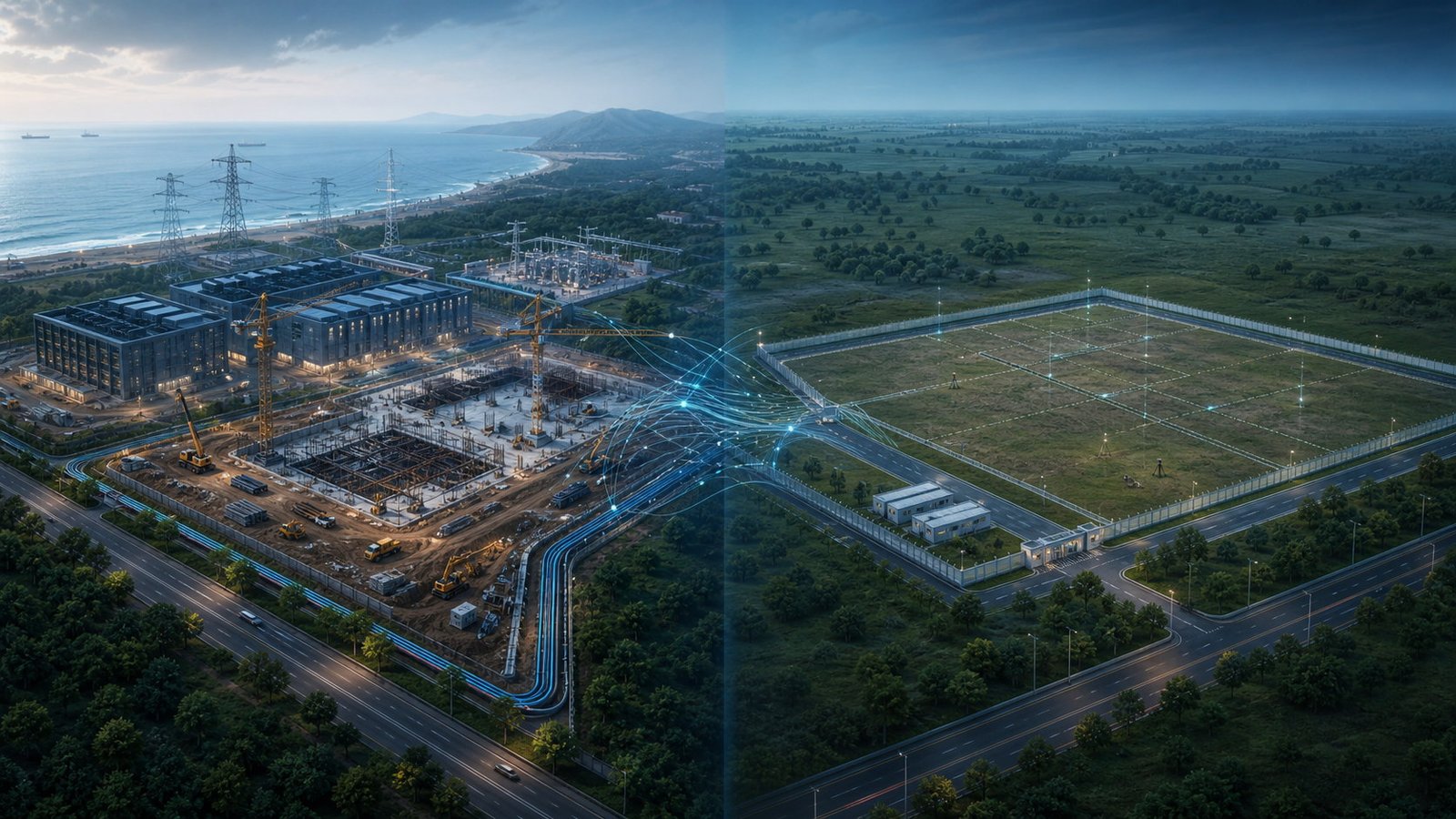
Groundbreaking, land secured and a live cloud region are three different milestones.
Status checked through 12 October 2026 (IST). “Same scale” here means comparable headline ambition—not a verified equivalence between live megawatts, IT load, or total site power.

The short version: Google’s official 28 April 2026 announcement says it broke ground at Tarluvada, Visakhapatnam, on a three-campus, gigawatt-scale AI hub. TCS subsidiary HyperVault’s 5 September filing says it secured 264 acres in Hyderabad for a campus of up to 1GW, to be developed in phases. Microsoft’s Hyderabad cloud region reached general availability on 6 August—but that is a live-service milestone, not a public megawatt figure for a campus. The Google and TCS headlines are not yet shown on a common capacity basis.
At a glance
| Project / service | Strongest dated public milestone in the sources reviewed | Public scale wording | What the release does not establish |
|---|---|---|---|
| Google AI hub, Visakhapatnam | Groundbreaking at Tarluvada on 28 April 2026; Google said this marked the start of construction. | Google calls it a gigawatt-scale AI hub / compute build across three data-centre campuses. At the ceremony, Adani Group director Jeet Adani described “nearly 1 GW in a single location.” | A shared IT-load or gross-power definition; MW by campus or phase; commissioned/live capacity. |
| TCS HyperVault, Hyderabad | HyperVault said it had secured 264 acres on 5 September 2026 for the campus. | Up to 1GW campus capacity, built in phases according to customer demand and technology requirements. | A common capacity boundary; first-phase MW; a dated campus groundbreaking or commissioning date in the cited filing. |
| Microsoft India South Central, Hyderabad | Microsoft announced general availability on 6 August 2026. | Three Availability Zones; eligible Microsoft Cloud services and workloads are available from the region as services roll out. No regional MW figure was published. | A directly comparable campus-capacity number, or evidence that Google’s or HyperVault’s named projects are live. |
The comparison is useful precisely because the milestones differ. The source record supports a construction-start milestone for Google, a land-secured milestone for HyperVault’s named Hyderabad campus, and a cloud-service availability milestone for Microsoft. It does not support treating all three as operational data-centre capacity—or treating the two gigawatt headlines as equivalent quantities.
Google Vizag: groundbreaking is a construction milestone, not a live-capacity figure
Google announced its first India AI hub in Visakhapatnam on 14 October 2025, describing an approximately US$15 billion investment over 2026–2030. The company presented that as a broad, multi-part AI-hub programme: data-centre infrastructure alongside new energy supply and expanded fibre / subsea connectivity. The $15 billion figure should therefore not be reported as confirmed construction capex for the data-centre campuses alone. Google’s original announcement describes the hub’s data-centre component as capable of gigawatt-scale compute.
On 28 April 2026, Google said it officially broke ground at Tarluvada, in Visakhapatnam, alongside AdaniConneX and Nxtra by Airtel. Google described the ceremony as marking the start of construction on the AI hub and said the project comprises three data-centre campuses. The same release ties the broader hub to an expanded fibre network, a clean-energy strategy, and the America–India Connect connectivity initiative. Google Cloud’s groundbreaking release is the primary source for that milestone and partner list.
That is a meaningful step beyond an announcement. It is not, by itself, proof that all three campuses have been built, that a stated gigawatt has been energised, or that a given amount of compute is serving customers. The release does not give phase-by-phase MW, a defined IT-load-versus-site-power boundary, or a commissioning figure.
There is also a useful bit of chronology behind the deck. A 6 April 2026 ET Telecom report said land had already been allocated across the planned sites ahead of the ceremony, including to Google subsidiary Raiden Infotech India Private Limited. That is secondary reporting, not the wording of Google’s groundbreaking announcement; it indicates that the ceremony was not the first land-related step. ET Telecom’s report is included only for this attributed context.
Finally, the wording itself deserves care. Google’s first announcement says “gigawatt-scale compute capacity.” Its April release says the hub consists of three campuses; a quotation from Jeet Adani describes “nearly 1 GW in a single location.” Those descriptions signal very large ambition, but the cited releases do not provide the campus-by-campus MW schedule or a technical definition that lets an outside reader translate the labels into a common measure of IT load, total facility power, or commissioned capacity.
TCS HyperVault Hyderabad: land secured, with a phased build-out still to be specified
The Hyderabad campus is the latest site-specific step in a broader HyperVault story. Those announcements are related, but they are not interchangeable:
- On 20 November 2025, TCS announced a strategic partnership with TPG to support the wider HyperVault AI data-centre business. TCS said HyperVault’s broader plan was to create capacity in excess of 1GW over the coming years. TCS described a funding mix of TCS and TPG equity plus debt, with the partners planning up to ₹18,000 crore across several years; TPG’s portion was stated as up to ₹8,820 crore. This was a platform-level financing announcement, not a capacity allocation for the later Hyderabad campus. TCS’s TPG announcement.
- On 19 February 2026, Tata Group, TCS and OpenAI announced a multi-year partnership. Its infrastructure component says TCS’s HyperVault unit and OpenAI agreed to develop an initial 100MW, with an option to scale to 1GW. The announcement does not identify Hyderabad as the location for that capacity. It is not sound to assign the 100MW—or the option—to this campus without a published site allocation. Tata Group’s partnership release.
- On 5 September 2026, HyperVault, a TCS subsidiary, said it had secured 264 acres in Hyderabad for an AI data-centre campus of up to 1GW. The company says development will be phased in line with customer demand and technology requirements. It says HyperVault and partners are expected to invest up to ₹70,000 crore to build and manage the infrastructure. The filing does not say that TCS alone will fund that amount. TCS’s official campus release and the BSE exchange filing are the primary sources for the land, campus scale, phasing and investment wording.
The distinction matters. A HyperVault-wide target above 1GW, an OpenAI partnership with an initial 100MW and an option to scale, and a named Hyderabad campus capped at “up to 1GW” are three statements with different scopes. The public announcements reviewed do not map the platform and partner capacity onto the Hyderabad site. They should not be added together, treated as separate blocks of delivered capacity, or presented as proof that the whole Hyderabad campus is contracted to OpenAI.
The same applies to the investment headlines. The earlier up-to-₹18,000-crore TPG/HyperVault funding plan and the later up-to-₹70,000-crore campus expectation have different disclosed scopes. The releases do not provide a project-finance reconciliation that would justify adding them as separate, non-overlapping sums. The ₹70,000-crore wording is an expectation for HyperVault and its partners, not a statement that TCS alone has already spent or committed that full amount.
The Telangana government’s release presents the campus as a major part of the state’s AI and Future City ambitions; the TCS/BSE-filed announcement identifies the location as Hyderabad and states 264 acres, but does not publish a parcel address. Telangana’s announcement describes the campus as more than 250 acres and a 1GW project.
For status language, the safe formulation is: land secured for a phased, up-to-1GW Hyderabad campus. In the cited campus filing, that is not the same thing as a dated groundbreaking, a commissioned first phase, or a live data-centre service. In the sources reviewed through the cut-off, no first-phase MW or campus commissioning date was stated. That is a statement about the public record reviewed—not a claim that no work or permitting activity has occurred.
Microsoft Hyderabad: a live cloud-region benchmark, not a third campus comparison
Microsoft announced that India South Central, its Hyderabad cloud region, reached general availability on 6 August 2026. Microsoft says the region has three Availability Zones and lets customers run eligible Microsoft Cloud services and workloads from Hyderabad, with services becoming available over time. It also lists early-access demand from Adani Group, Bajaj Finserv, HDFC Bank and PB Pay. Microsoft’s launch announcement is specific about service availability, but publishes no regional MW figure.
This is a useful benchmark for the deck’s third milestone: a cloud service region can be generally available while the company still does not publish the power capacity of the region. The service label says something real about customer access to eligible services; it does not disclose how many megawatts sit behind that service, nor does it establish that either Google’s Vizag hub or HyperVault’s named Hyderabad campus is commercially live.
Microsoft’s announcement names Puneet Chandok, President of Microsoft India and South Asia. The region is one of four Microsoft cloud regions that the company says it operates in India. It remains a different unit of analysis from the Google and TCS campus announcements: region, Availability Zones, individual data centres, MW and cloud-service availability should not be collapsed into one metric.
Why “1GW vs 1GW” is not yet an apples-to-apples comparison
A gigawatt is 1,000 megawatts, but the arithmetic does not define what a project is measuring. A data-centre capacity figure could describe, for example, power provisioned to IT equipment, the total power demand of the facility, an ultimate campus design envelope, or a phase that has actually been installed and tested. Those are different boundaries and different stages.
The Uptime Institute distinguishes power-demand capacity from IT-equipment capacity and defines power usage effectiveness (PUE) by comparing total facility power with IT power. That is why an unqualified “1GW” headline cannot be assumed to mean 1GW of server load, 1GW of utility draw, or 1GW already commissioned. Uptime Institute’s glossary and its 2025 Global Data Center Survey explain the distinction between total facility power and IT-equipment power.
| Term | What it can mean | Why it matters here |
|---|---|---|
| IT load | Power used by servers, accelerators, storage and network equipment. | This is closest to the computing hardware, but it is not automatically the same as the site’s total electricity demand. |
| Facility / utility power | The broader power requirement, including IT equipment plus cooling, electrical conversion and other supporting systems. | It can be higher than the IT load. A published number needs a boundary and a measurement point. |
| Campus design capacity | A planned ceiling or long-term envelope that may be built in phases. | “Up to” and “gigawatt-scale” do not mean every phase exists today. |
| Commissioned capacity | A specific installed and tested phase that is ready for use. | It is the key bridge between a plan and usable live MW; the cited Google and TCS campus releases do not state a comparable commissioned figure. |
| Cloud-region general availability | Eligible cloud services are available to customers from a geographic region, subject to the provider’s service rollout. | It is meaningful service evidence, but does not by itself disclose the region’s MW or map to one announced campus. |

So the fairest answer to the title is: similar order of magnitude in public ambition; not proven to be the same amount or kind of capacity. Neither company’s cited announcement establishes that its full gigawatt headline is live, commissioned IT load. Nor is there enough disclosure here to conclude that the figures are different in a specific technical sense—the public record simply does not define the basis well enough to make that comparison.
A milestone ladder for reading the headlines
The simplest way to avoid conflating the claims is to ask what stage the evidence actually supports:
- Announced: a company or public body states an intention, target or investment plan.
- Land secured: a site or parcel is reported secured; that says nothing by itself about construction or power commissioning.
- Groundbreaking / construction start: a public milestone for physical work. It does not mean the whole campus is complete.
- Commissioned phase: installed equipment and supporting systems have been tested and made available for use; identify the phase and MW boundary.
- Service generally available: a cloud provider makes eligible services available in a region. This is a service milestone and may not disclose the region’s physical capacity.


What would make the comparison stronger?
For Google, the most useful next disclosures would be phase-by-phase MW, a clear statement of whether each figure is IT load or total site power, campus-level commissioning evidence, and a dated indication of when customer-serving capacity becomes available. The three-campus structure makes site-level detail especially valuable.
For TCS HyperVault, the next evidence points are a dated construction-start milestone for the Hyderabad campus, a first-phase MW and its measurement boundary, an expected commissioning window, and a public explanation of how any customer/partner capacity—including the OpenAI partnership—is allocated between HyperVault sites. A single campus ceiling is not a substitute for a phase schedule.
For Microsoft, the relevant follow-up is service-by-service availability and the scale of the region if Microsoft chooses to disclose it. General availability already establishes a different kind of milestone; it does not need an invented MW estimate to be meaningful.
The companies and people named in the source record
These are the principal organisations and public-facing leaders named in the linked announcements; inclusion identifies the source record and does not imply endorsement of this article.
- Google / Andhra Pradesh: Google Cloud CEO Thomas Kurian and infrastructure executive Bikash Koley; Google’s project partners AdaniConneX and Nxtra by Airtel; Adani Group directors Karan Adani and Jeet Adani; Bharti Airtel executive vice-chair Gopal Vittal; Union minister Ashwini Vaishnaw; Andhra Pradesh Chief Minister N. Chandrababu Naidu; and state IT minister Nara Lokesh. These names appear in Google’s groundbreaking release.
- TCS / HyperVault / Telangana: HyperVault is a TCS subsidiary; TCS CEO K. Krithivasan, COO Aarti Subramanian, HyperVault president V. Rajanna, and HyperVault CEO and managing director Deepesh Kiran Nanda are named in the company/state materials. N. Chandrasekaran, chairman of Tata Sons, was central to the broader partnership discussions. TPG is HyperVault’s strategic investment partner; OpenAI is a separate infrastructure partner whose public announcement does not allocate the initial capacity to the Hyderabad site. Telangana Chief Minister A. Revanth Reddy and IT & Industries Minister Duddilla Sridhar Babu are named in the state’s project announcement. Sources: the TCS/BSE campus filing, TCS’s TPG release, and Tata Group’s OpenAI partnership release.
- Microsoft: Puneet Chandok, President of Microsoft India and South Asia, is quoted in the region-launch announcement. Microsoft lists Adani Group, Bajaj Finserv, HDFC Bank and PB Pay among early-access enterprises.
Frequently asked questions
Are Google and TCS both building 1GW data centres?
Both have public gigawatt-class headlines: Google describes a gigawatt-scale AI hub across three campuses, while HyperVault describes a Hyderabad campus of up to 1GW. The releases do not define a shared boundary or establish equivalent live capacity. The careful description is similar headline scale, different milestones, unverified like-for-like capacity.
Has Google started construction in Vizag?
Google’s 28 April 2026 release says it broke ground at Tarluvada and that the milestone marked the start of construction on the AI hub. That statement does not publish phase MW or prove that all planned campuses are already commissioned.
Has TCS HyperVault started construction in Hyderabad?
The TCS/BSE-filed 5 September 2026 release says HyperVault secured 264 acres for the campus and that development will be phased. It does not provide a dated campus groundbreaking or commissioning milestone. This article does not infer that no on-site activity has occurred; it reports what the cited public announcement establishes.
Is OpenAI’s 100MW commitment assigned to the Hyderabad campus?
The Tata Group release states an initial 100MW partnership with an option to scale to 1GW, but does not name the Hyderabad campus as the location. A site allocation should not be assumed from that release alone.
Is Microsoft’s Hyderabad cloud region live?
Microsoft announced general availability for India South Central on 6 August 2026, with three Availability Zones and eligible services available from Hyderabad as services roll out. That is a live cloud-service milestone; Microsoft did not publish a region MW figure in the announcement.
Method and correction note
This is a dated reading of the linked company releases, exchange filing and government announcement, checked through 12 October 2026 (IST). The land-allotment detail for Google is attributed to ET Telecom and is not presented as Google’s own wording. The article is not an independent site inspection or an engineering audit. Factual corrections—especially on capacity definitions, phase MW, site allocation and dated construction/commissioning milestones—are welcome before publication.
Sources
- Google, “Our First AI Hub in India, Powered by a $15 Billion Investment,” 14 October 2025.
- Google Cloud, “Google Breaks Ground on India AI Hub,” 28 April 2026.
- ET Telecom, report on Google’s planned 28 April groundbreaking and site land allocation, 6 April 2026. Secondary context only.
- TCS, “TCS’ HyperVault to establish large-scale AI data center campus in Telangana,” 5 September 2026; BSE exchange filing of the same release.
- Government of Telangana, TCS–HyperVault delegation and campus announcement, 5 September 2026.
- TCS, “TCS Secures $1Bn Investment from TPG to Accelerate AI Data Center Business HyperVault,” 20 November 2025.
- Tata Group, “Tata group and OpenAI forge foundational partnership,” 19 February 2026.
- Microsoft, “Microsoft’s newest India datacenter region goes live,” 6 August 2026.
- Uptime Institute, Glossary of Digital Infrastructure Sustainability.
- Uptime Institute, Global Data Center Survey 2025.
Continue exploring Gridvik’s data-centre research
For the next useful layer of context, continue with these related Gridvik guides:
- India’s data-centre live-status audit: STT GDC, CapitaLand and Keppel — separates operating capacity from construction and pipeline.
- The 500MW double-count claim: a 170MW parent–phase audit — shows how a site phase may sit inside a wider target, while keeping the national double-count claim unproven.
- Singapore 200MW, Jurong 700MW: does capital shift to India? — tests the difference between capacity announcements, FDI flows and a provable capital redirection.
- India Data Centre Investment Map 2026 — tracks investment scope, capital structures and overlap without adding unlike commitments.
- India data-centre power and policy bottlenecks — explores grid readiness and execution milestones.
- Fibre and connectivity for India data-centre site selection — follows the connectivity layer behind the Vizag AI-hub announcement.