UP’s 50% Data-Centre Land Subsidy: What It Covers—and Where Noida Sits
Gridvik Research · Policy notified 9 July 2026 · Research cutoff: 1 November 2026
UP’s 2026 policy offers 50% land support in Bundelkhand and Purvanchal—but only on State Agency land and after commercialisation. Noida is in the 25% band.
Notified policyThe 2 GW+ capacity and ₹2 lakh crore+ investment figures are forward-looking policy targets, not achieved output.
The practical answer: Uttar Pradesh offers a 50% land subsidy in Bundelkhand and Purvanchal, versus 25% in Madhyanchal and Paschimanchal. The 2026 policy says the land must be purchased or leased from a State Agency at prevailing sector rates; the State pays the subsidy to that agency after the project commercialises, in proportion to land used in phases. Noida/Greater Noida are in Gautam Buddha Nagar, which the policy appendix assigns to Paschimanchal—so the applicable regional rate there is 25%.[1]
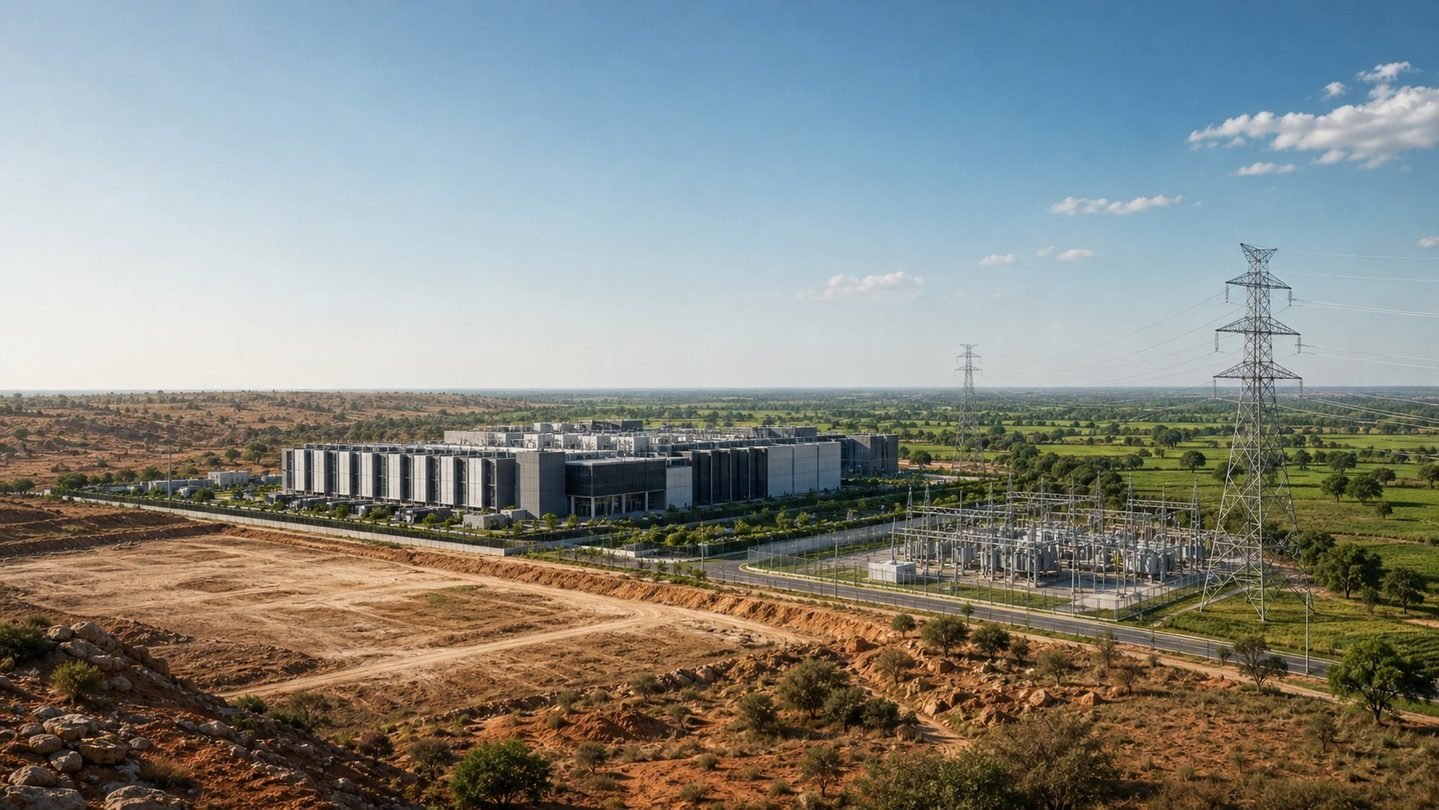
Illustrative artwork—not a map, an identified parcel or a photograph of an existing Uttar Pradesh facility.
Bundelkhand + Purvanchal
50%On prevailing sector rates for eligible State Agency land.
Madhyanchal + Paschimanchal
25%Gautam Buddha Nagar, including Noida/Greater Noida, is in this band.
When land support is paid
Post-commercialisationPhased, proportionate to land used; State Agency adjusts the payment plan.
Appendix 12 of the notified policy divides Uttar Pradesh’s districts into four regions. Bundelkhand and Purvanchal receive the higher rate; Madhyanchal and Paschimanchal receive the lower one. The appendix names 75 districts: 37 in the 50% bands and 38 in the 25% bands.[1]
50% land subsidy
Bundelkhand · 7 districts
Jhansi, Jalaun, Lalitpur, Banda, Chitrakoot, Hamirpur and Mahoba.
50% land subsidy
Purvanchal · 30 districts
Includes Ayodhya, Gorakhpur, Prayagraj, Varanasi, Mirzapur, Azamgarh, Gonda and Basti divisions.
25% land subsidy
Madhyanchal · 12 districts
Includes Lucknow and Kanpur divisions.
25% land subsidy
Paschimanchal · 26 districts
Includes Agra, Aligarh, Moradabad, Meerut, Saharanpur and Bareilly divisions; Gautam Buddha Nagar is listed here.
That places Noida and Greater Noida in the 25% band, not the 50% band. The policy appendix lists Gautam Buddha Nagar under Paschimanchal; the Gridvik Registry’s location records for Noida and Greater Noida use that district designation.[1][8]
Open the complete district roster transcribed from Appendix 12
The policy does not promise a 50% discount on any private-market plot, nor a cheque to a developer before construction. Clause 7.1.3 ties the subsidy to the prevailing sector rate on land purchased or leased from a State Agency. The defined agencies include Industrial Development Authorities; the UP Housing & Development Board and Development/Special Area Development Authorities under the Housing and Urban Planning Department; and other State institutions notified by the Government.[1]
Payment sequence: The State disburses the subsidy to the relevant State Agency only after commercialisation. The amount is proportionate to the land used in each phase within the policy period, and the agency adjusts it in the enterprise’s payment plan. For a developer, that means a conditional, post-operation adjustment—not an upfront 50% reduction in the asking price.
The policy also allows land support for captive solar plants established with a data centre only where no land subsidy is taken for that land under another Central or State policy. Land reserved for future-scale captive solar expansion is not eligible under the 2026 clause. These are land-use conditions, not a general solar-project subsidy.[1]
Who can qualify—and when can an incentive be claimed?
The 2026 policy separates data-centre parks, units and grouped edge proposals. A proposal must fit one of these categories; captive data-centre units and captive edge centres are excluded. Applicants are distinct legal entities incorporated and registered in India, and the investment proposal is submitted through the Nivesh Mitra portal.[1]
Category
Policy threshold
Commercialisation gate for incentive disbursement
Data Centre Park
At least 40 MW total load capacity.
Commercialised operation of 40 MW.
Data Centre Unit
More than 2 MW and less than 40 MW total load; captive units excluded.
Commercialised operation above 2 MW.
Edge Data Centres
One proposal with at least 10 centres, each at least 50 kW, and at least 2 MW cumulative capacity; captive edge centres excluded.
At least 2 MW cumulative operation across 10 or more centres.
Financial incentives apply only after a Letter of Comfort (LoC) is issued. The LoC is an approval instrument that identifies the project, proposed investment, specified incentives and conditions; it is not a blanket guarantee beyond those stated terms. The policy says an investor may apply for disbursement only after the relevant commercialisation threshold is met. Its defined commencement date is the first valid invoice to an external customer for actual data-centre services—not a ribbon-cutting or a capacity announcement.[1]
Timing: The policy generally gives three years from the LoC to start commercial operations; proposals committing 200 MW of data-centre capacity can receive a further two-year extension under the stated provision. Existing eligible holders of a 2021-policy LoC may remain under that policy, subject to its conditions and applicable Government Orders.[1]
Other 2026 incentives: useful, but conditional
The land rate is only one part of the policy. These headline benefits have separate categories, ceilings, durations and qualifying events; the project’s LoC and current implementation rules control the actual claim.[1]
Support
What the notified policy says
Important limit
Park interest reimbursement
60% of annual interest paid on an eligible term loan for the initial 7 years.
₹10 crore per year; ₹50 crore overall per park, before any qualified booster.
Unit capital subsidy
7% of eligible fixed capital investment (core IT, MEP, power/cooling and related systems).
Land and building excluded; ₹20 crore total ceiling, paid over 10 years, capped at ₹2 crore per year.
Unit electricity duty
100% exemption for 10 years after commencement of commercial operations.
Applies to eligible Data Centre Units, subject to the policy and approved project terms.
Dual-grid support for parks
Department of IT & Electronics reimburses the lower-cost of two grid lines; the park bears the other.
Limited to the first 8 parks or an additional 2 GW of capacity under the policy, whichever comes first.
Stamp duty
100% exemption on the eligible government-authority/entity land transaction; 50% on the second park-to-unit transaction.
Secured by a bank guarantee for the exempt amount, released at commencement of commercial operation.
Power-charge concessions
Transmission/wheeling concessions vary by transaction and power source; in-state renewable purchases receive a different rate from ordinary intrastate purchases.
Time and capacity limits apply, including the first 8 parks or additional 2 GW cap in the relevant clause.
The policy adds conditional Tier III/IV certification-charge reimbursement, AI-compute boosters tied to minimum installed FP64 compute units, and green-operation boosters linked to certification, PUE and renewable-energy share. Edge proposals can receive unit incentives (other than the green-operations booster) and a separate internet-cost reimbursement of 25%, capped at ₹2.5 lakh per edge centre per year for its first three commercial years. These are not automatic add-ons: each has its own evidence requirements and limits.[1]
A cheaper plot is not a ready data-centre site
The policy addresses more than land: for projects in State Agency areas, it requires water availability to be assessed before land allocation and says the agency should ensure 24×7 uninterrupted water supply at applicable charges before the LoC, subject to the stated conditions. Water NOCs, treatment, efficient cooling and wastewater reuse also matter. It provides for 24×7 power supply to parks and units subject to two dedicated feeders being arranged by the park or unit.[1]
Those provisions do not certify that a particular parcel has spare power, water, fibre routes, approvals or commissioning capacity today. Investors should confirm parcel availability and site-specific utility evidence independently; the 50%/25% land band is a price-support rule, not a site-readiness rating.
What can the prior-policy location record prove?
The 2021 policy already used the same broad 25%/50% regional split; the 2026 policy is not the first time Bundelkhand and Purvanchal received the higher land rate.[5] The official Cabinet note of 6 July 2026 says that, under the previous framework, 7 projects had become operational out of 6 data-centre parks and 2 units. UPLC’s policy page separately lists 7 of 8 projects as commercialised and 133 MW in its commercialisation panel.[2][3]
But an aggregate is not a location roster. The UPLC panel does not give a complete address for each project beside that 7/8 count. It cannot, by itself, establish the location of every commercialised project. The article therefore does not infer a statewide siting pattern from the aggregate.
For a narrower, reproducible check, the Gridvik Registry’s 242 published record pages were searched on 1 November 2026 for an Uttar Pradesh/Noida location entry. Five pages matched. Three document an operational or partly operational facility; two are proposal or announcement-stage records. This is a count of Registry pages, not campuses, approvals or the same denominator used by UPLC.[8]
There is also a useful proposal-stage caution. STT GDC India’s 10 February 2023 MoU release describes two proposed parks in Noida/Greater Noida and an additional regional data-centre unit in Lucknow, subject to demand, policy support and techno-commercial viability. That is not evidence of a live Lucknow facility; it shows why a count of signed MoUs or proposals must not be presented as a count of operating sites.[6]
The public evidence reviewed supports a clear policy geography—Noida/Greater Noida are in the 25% band—and a limited set of named Registry examples. It does not supply a complete, dated, address-by-address roster that can be matched one-for-one to UPLC’s commercialisation count.
Targets, proposals and operations are different stages
The 2026 policy aspires to add more than 2 GW of capacity and mobilise more than ₹2 lakh crore in investment. These are forward-looking policy targets over the policy period, not achieved capacity or money already spent.[1]
Stage / source
Published figure
Correct reading
2026 policy target
Additional 2 GW+ capacity; more than ₹2 lakh crore investment.
Indicative future outcomes, not current operating capacity or realised investment.
2021-policy proposals, Invest UP snapshot
644 MW proposed capacity and ₹21,342.90 crore proposed investment as of June 2025.
Proposal-stage statistics; not an operational total.
2021-policy commercialisation panel, UPLC
7 of 8 listed projects; 133 MW commercialised.
UPLC’s page-level status panel as accessed 1 Nov 2026; the panel does not state its own cutoff date or publish the full site roster.
These figures describe different stages and come from separate official pages. They should not be added, subtracted or relabelled as if they were a single operational series. The 2026 policy’s additional-capacity target is also distinct from the 2021-policy project count and from proposed capacity reported in 2025.[3][4]
Policy dates and the transition from 2021
Date
What happened
Why it matters
27 Jan 2026
The Cabinet note says the 2021 policy (First Amendment 2022) had expired.
Do not treat old policy approvals and new-policy targets as one programme.
6 Jul 2026
The Uttar Pradesh Cabinet approved the 2026 policy.
Cabinet approval date; not the policy’s notification date.
9 Jul 2026
The final policy was notified under G.O. No. 536/78-2-2026/E-105226.
The policy’s five-year operative period runs from official notification unless amended or repealed sooner.
12 Oct 2026
UPLC’s policy page lists the implementation guidelines with this date.
Applicants should check the current guidelines and their LoC; the linked guideline PDF could not be retrieved for this review.
Once the 2026 policy took effect, the 2021 policy was repealed for new cases. The transition clause preserves admissible old-policy benefits for an entity holding a 2021-policy LoC that has partially or fully availed incentives or concessions, subject to prevailing Government Orders. Where an LoC holder has not met the required operationalisation criteria, the State may consider an extension; the notified text says any such extension cannot exceed three years.[1][2]
Quick answers
Does the 50% subsidy apply to Noida or Greater Noida?
No. Gautam Buddha Nagar is listed under Paschimanchal, whose land-subsidy rate is 25%.
Is the 50% a discount on any privately purchased plot?
No. The notified land clause covers eligible purchase/lease from State Agencies at prevailing sector rates, with post-commercialisation, phased adjustment by the agency.
Can a project receive financial incentives before it is operating?
It needs an LoC for financial incentives, but the policy permits disbursement applications only after the relevant category’s commercialisation threshold is met.
Has Uttar Pradesh already added 2 GW under the 2026 policy?
No. The 2 GW+ figure is the policy’s additional-capacity target, not achieved output.
Sources and method
Primary policy text controls the eligibility, rate map and payment conditions. Official project-status statistics are quoted with their labels and dates. The location check is deliberately limited to a dated count of published Registry pages; no Registry-page count is presented as a complete state project roster.
Government of Uttar Pradesh, Uttar Pradesh Data Centre Policy 2026, G.O. No. 536/78-2-2026/E-105226, 9 July 2026. Clauses 5–8 and Appendix 12 are the primary sources for thresholds, financial benefits, State Agency definition, commercialisation conditions and district bands.Official policy PDF; the article quotes the notified text, not a draft.
Uttar Pradesh Information & Public Relations Department, Cabinet decisions press note, 6 July 2026. Records Cabinet approval of the new policy, the prior policy’s expiry as stated by the Government, and seven operational projects out of six parks and two units under the earlier framework.Official Cabinet note; reports projects, not seven individual buildings or a location roster.
U.P. Electronics Corporation (UPLC), Uttar Pradesh Data Center Policy page, accessed 1 November 2026; page states it was last updated 12 October 2026. Its commercialisation panel lists 7 of 8 projects and 133 MW but does not publish site addresses alongside that panel. The page also links the current implementation guidelines.The implementation-guidelines PDF listed on the page could not be retrieved during this review; confirm current administrative steps and project-specific conditions against the guidelines and LoC.
Invest UP, IT & ITeS in Uttar Pradesh, official KPI and policy statistics labelled June 2025. States 644 MW proposed data-centre capacity and ₹21,342.90 crore proposed investment.Proposal-stage snapshot; not treated here as operational capacity or realised investment.
Government of Uttar Pradesh, Uttar Pradesh Data Center Policy 2021, 9 April 2021. Used only to verify that the broad regional 25%/50% split pre-dated the 2026 policy.The 2026 policy’s transition provisions separately protect eligible existing LoC holders under the applicable older Government Orders.
STT GDC India, “STT GDC India signs MoU with UP Government”, 10 February 2023. Describes two proposed parks in Noida/Greater Noida and an additional regional data-centre unit in Lucknow, subject to demand, policy support and techno-commercial viability.Company-reported MoU proposal; not evidence that a Lucknow unit was built or became operational.
Invest UP, Yotta D1 inauguration release, 1 November 2022. Identifies Yotta D1 in Greater Noida and reports its launch; used as a location example, not as a full project roster.Official state press release; company and project figures in the release are attributed to the source.
Gridvik public Registry record pages checked 1 November 2026: PRJ-007, PRJ-008, PRJ-022, PRJ-023 and PRJ-035.Method: location fields with explicit Uttar Pradesh, Noida or Greater Noida text in the 242-page record set; one page per record ID. Pages can cover phases or umbrella proposals. This is a Gridvik Registry page count, not an official state count, not a count of unique campuses and not a complete population of Uttar Pradesh data-centre sites.
Bottom line: The 2026 policy assigns 50% land support to eligible State Agency land in Bundelkhand and Purvanchal, but pays it only after commercialisation in proportion to phased land use. Noida/Greater Noida are in the 25% Paschimanchal band. The state’s prior-policy project count is real, but the published status panel does not provide the complete location roster needed for a statewide siting claim.
◉We Value Your Privacy
We use cookies to improve your experience and analyze traffic. By clicking "Allow All", you consent to our use of cookies. See our Privacy Policy.